Are you preparing for the LTO Comprehensive Driver’s Education (CDE) Online Validation Exam?
Renewing your license? Read our complete Driver’s License Renewal Philippines 2026 Guide.
The CDE exam is part of the driver education system of the Land Transportation Office (LTO) and may be required for certain driver’s license renewal transactions.
The good news is that the exam is relatively manageable if you understand basic Philippine traffic rules, road signs, right-of-way rules, and road safety laws.
This 2026 LTO CDE reviewer contains 50 practice questions and answers based on topics covered in official LTO driver education materials.
Important: These are practice questions designed to help you study. They are not leaked questions and there is no guarantee that the exact same questions will appear in your actual CDE examination.
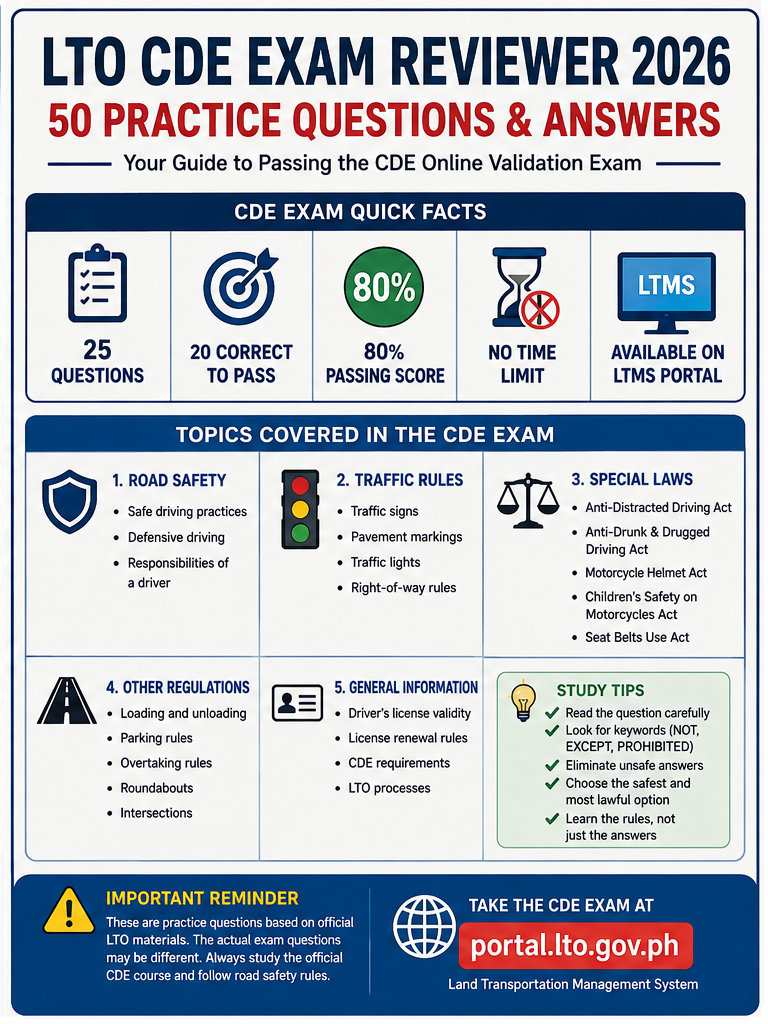
LTO CDE Exam Quick Facts
Before starting the reviewer, here are the most important things to know.
- Number of questions: 25
- Passing score: 20 correct answers
- Passing percentage: 80%
- Time limit: None
- Available through: LTMS Portal
- Purpose: CDE certification for applicable driver’s license transactions
Because there is currently no time limit, you can carefully read each question before submitting your answer.
Part 1: CDE Exam Basics
1. How many questions are in the CDE Online Validation Exam?
A. 20
B. 25
C. 30
D. 40
Correct Answer: B. 25
The CDE Online Validation Exam contains 25 questions.
2. How many correct answers do you need to pass the CDE exam?
A. 15
B. 18
C. 20
D. 25
Correct Answer: C. 20
You must answer at least 20 out of 25 questions correctly.
3. What is the passing percentage for the CDE exam?
A. 60%
B. 70%
C. 75%
D. 80%
Correct Answer: D. 80%
A score of at least 80% is required.
4. Is there a time limit for the CDE Online Validation Exam?
A. 15 minutes
B. 30 minutes
C. One hour
D. No time limit
Correct Answer: D. No time limit
The official LTMS examination page states that there is currently no time limit.
5. Where can you access LTO’s online CDE services?
A. MMDA Portal
B. LTMS Portal
C. DFA Portal
D. LTO Facebook page
Correct Answer: B. LTMS Portal
The Land Transportation Management System or LTMS Portal provides LTO e-learning and CDE services.
Part 2: Road Signs and Pavement Markings
6. What do double solid yellow or white lines generally mean?
A. Overtaking is encouraged
B. Parking is allowed
C. Overtaking or crossing is prohibited
D. U-turns are mandatory
Correct Answer: C. Overtaking or crossing is prohibited
Double solid lines indicate that vehicles should not cross the lines or overtake.
7. What does a broken yellow line generally allow?
A. No vehicle may cross
B. Crossing or overtaking with proper caution
C. Parking only
D. Motorcycles only
Correct Answer: B. Crossing or overtaking with proper caution
Drivers may cross a broken yellow line when it is safe to do so.
8. There is one solid line beside one broken line. Who may overtake?
A. Vehicles on both sides
B. Nobody
C. Vehicles on the broken-line side, when safe
D. Vehicles on the solid-line side only
Correct Answer: C. Vehicles on the broken-line side, when safe
Passing is permitted from the side with the broken line but not from the solid-line side.
9. What does a single solid yellow or white line generally mean?
A. Overtaking is prohibited
B. Overtaking is required
C. Parking is required
D. Only motorcycles may cross
Correct Answer: A. Overtaking is prohibited
According to LTO driver education materials, overtaking from either direction is prohibited at a single solid line, although crossing movement may be permitted when appropriate.
10. What must you do when approaching a STOP sign?
A. Slow down only
B. Honk and continue
C. Come to a full stop and yield when necessary
D. Turn right immediately
Correct Answer: C. Come to a full stop and yield when necessary
A rolling stop is not considered a proper stop.
11. What does a GIVE WAY or YIELD sign require?
A. Always accelerate
B. Give priority to vehicles already in or closely approaching the intersection
C. Stop for exactly five seconds
D. Turn around
Correct Answer: B. Give priority to vehicles already in or closely approaching the intersection
Proceed only when it is safe.
12. A traffic light turns green. Can you immediately enter the intersection?
A. Always
B. Only if the intersection is clear and you yield to lawful traffic and pedestrians already there
C. Never
D. Only after using your horn
Correct Answer: B.
A green light does not give permission to hit or block vehicles or pedestrians already lawfully within the intersection.
13. When a right turn on red is permitted, what should you do first?
A. Accelerate
B. Stop, then yield before turning
C. Honk twice
D. Turn without stopping
Correct Answer: B. Stop, then yield before turning
You must yield to pedestrians and cross traffic before proceeding.
Part 3: Right-of-Way Rules
14. Who generally has priority when entering a roundabout?
A. The vehicle entering fastest
B. The largest vehicle
C. Vehicles already inside the roundabout
D. Motorcycles
Correct Answer: C. Vehicles already inside the roundabout
Drivers entering a roundabout should yield to vehicles already circulating inside it.
15. What should you do before exiting a roundabout?
A. Turn off your headlights
B. Signal your intention and check your mirror
C. Stop inside the roundabout
D. Change lanes without signalling
Correct Answer: B.
Signal and check that your movement can be completed safely.
16. Two vehicles reach an uncontrolled intersection at about the same time. Who generally has priority?
A. The vehicle on the left
B. The vehicle on the right
C. The faster vehicle
D. The more expensive vehicle
Correct Answer: B. The vehicle on the right
At an intersection without signs or signals, the vehicle on the left should generally yield to the vehicle on the right.
17. Two vehicles stop at a STOP-controlled intersection at the same time. Who should yield?
A. The vehicle on the right
B. The vehicle on the left
C. Neither vehicle
D. Both must reverse
Correct Answer: B. The vehicle on the left
The vehicle on the left should yield to the vehicle on the right.
18. A vehicle is already inside an intersection. Who normally has priority?
A. The vehicle already inside
B. The vehicle approaching fastest
C. A vehicle flashing its headlights
D. The vehicle with more passengers
Correct Answer: A. The vehicle already inside
Vehicles already occupying the intersection are generally given priority.
19. When two vehicles meet on a steep road where passing is difficult, which vehicle generally deserves priority?
A. Downhill vehicle
B. Uphill vehicle
C. Heavier vehicle
D. Newer vehicle
Correct Answer: B. Uphill vehicle
LTO road-rule materials identify the uphill vehicle as having priority in this type of situation.
20. Before changing lanes, what should a driver do?
A. Change lanes immediately
B. Signal and check mirrors and surrounding traffic
C. Accelerate without checking
D. Use the horn continuously
Correct Answer: B.
Always make sure the movement can be completed safely.
21. Before turning, stopping, or moving away from a direct line of travel, what should you do?
A. Signal your intention and ensure the movement is safe
B. Turn immediately
C. Stop in the middle of the road
D. Flash your headlights only
Correct Answer: A.
Drivers must make sure their intended movement will not endanger other road users.
22. Is overtaking at a railway grade crossing considered safe?
A. Yes
B. Only at night
C. No
D. Only for motorcycles
Correct Answer: C. No
Overtaking at railway crossings is prohibited and dangerous.
Part 4: Safe Driving Practices
23. What should you do when approaching an area with pedestrians?
A. Increase speed
B. Be prepared to slow down or stop
C. Ignore pedestrians
D. Drive on the shoulder
Correct Answer: B.
Drivers must always anticipate pedestrian movement.
24. What is the safest action when visibility is poor?
A. Drive faster
B. Reduce speed and increase caution
C. Turn off your lights
D. Follow the vehicle ahead closely
Correct Answer: B.
Reduced visibility requires lower speed and increased following distance.
25. What should you do if the vehicle ahead suddenly brakes?
A. Accelerate
B. Prepare to stop while maintaining control
C. Immediately overtake
D. Turn off your engine
Correct Answer: B.
Maintaining sufficient following distance gives you enough time to respond.
26. What should you do before driving?
A. Check that the vehicle is safe and roadworthy
B. Only check the fuel level
C. Only clean the windshield
D. Nothing
Correct Answer: A.
Vehicle condition is an important part of road safety.
27. Is aggressive driving or road rage considered safe driving behavior?
A. Yes
B. Only in traffic
C. No
D. Only on expressways
Correct Answer: C. No
Road courtesy and avoiding road rage are specifically covered by LTO driver education.
28. What is one of the driver’s most important responsibilities?
A. Reaching the destination as quickly as possible
B. Protecting the safety of passengers and other road users
C. Always overtaking slower vehicles
D. Avoiding all traffic lights
Correct Answer: B.
Responsible driving means considering the safety of everyone using the road.
Part 5: Mobile Phones and Distracted Driving
29. Is it legal to hold and use a mobile phone while driving?
A. Yes
B. No, except where a legal exemption applies
C. Only in heavy traffic
D. Only below 20 km/h
Correct Answer: B.
Republic Act No. 10913 prohibits distracted driving involving handheld communication or computing devices.
30. Can you text while temporarily stopped at a red traffic light?
A. Yes
B. No
C. Only during daytime
D. Only if no police officer is nearby
Correct Answer: B. No
The Anti-Distracted Driving Act specifically covers vehicles temporarily stopped at a red light.
31. Can hands-free calling be allowed while driving?
A. Never
B. Yes, provided the device does not interfere with the driver’s line of sight
C. Only for professional drivers
D. Only inside Metro Manila
Correct Answer: B.
Hands-free functions may be used if the device placement does not obstruct the driver’s view.
32. Why is using a handheld phone while driving dangerous?
A. It increases tire wear
B. It distracts the driver’s attention from the road
C. It makes the engine hotter
D. It damages the battery
Correct Answer: B.
Even a short distraction can significantly increase crash risk.
Part 6: Motorcycle Safety
33. Who must wear a standard protective helmet on a motorcycle?
A. Only the driver
B. Only the passenger
C. Both driver and back rider
D. Nobody on short trips
Correct Answer: C. Both driver and back rider
Philippine law requires motorcycle riders and back riders to use standard protective helmets.
34. Does the helmet requirement only apply to long motorcycle trips?
A. Yes
B. No
C. Only on expressways
D. Only outside cities
Correct Answer: B. No
The helmet law applies whether the journey is long or short.
35. What type of helmet should be used?
A. Any plastic helmet
B. A standard protective helmet compliant with applicable DTI standards
C. A bicycle helmet
D. A construction helmet
Correct Answer: B.
Motorcycle helmets should comply with Philippine safety standards.
36. A child is riding as a motorcycle passenger on a road covered by the child motorcycle safety law. Which conditions should be met?
A. The child’s feet can reach the foot pegs
B. The child can hold the rider’s waist
C. The child wears a standard protective helmet
D. All of the above
Correct Answer: D. All of the above
These are key conditions under the Children’s Safety on Motorcycles Act.
37. Is there an exception when a child needs immediate medical attention?
A. No
B. Yes
C. Only at night
D. Only with police permission
Correct Answer: B. Yes
The law provides an exception for cases requiring immediate medical attention.
Part 7: Seat Belts and Special Laws
38. Are drivers required to wear seat belts in covered vehicles?
A. Yes
B. No
C. Only on expressways
D. Only when carrying passengers
Correct Answer: A. Yes
The Seat Belts Use Act requires seat-belt use for covered drivers and passengers.
39. Which law is known as the Anti-Distracted Driving Act?
A. RA 8750
B. RA 10054
C. RA 10913
D. RA 10666
Correct Answer: C. RA 10913
RA 10913 prohibits specified forms of distracted driving.
40. Which law is known as the Motorcycle Helmet Act?
A. RA 10054
B. RA 10930
C. RA 8750
D. RA 4136
Correct Answer: A. RA 10054
The law requires standard protective helmets for motorcycle riders and back riders.
41. Which law covers the safety of children aboard motorcycles?
A. RA 10586
B. RA 10666
C. RA 10913
D. RA 8750
Correct Answer: B. RA 10666
RA 10666 establishes safety requirements for children riding motorcycles in covered situations.
42. Which law addresses driving under the influence of alcohol or dangerous drugs?
A. RA 10586
B. RA 10054
C. RA 10913
D. RA 10666
Correct Answer: A. RA 10586
Driving under the influence is a serious road safety violation.
Part 8: Driver’s License and Renewal Questions
43. What is the standard validity period of a Philippine driver’s license?
A. 1 year
B. 3 years
C. 5 years
D. 15 years
Correct Answer: C. 5 years
The standard driver’s license validity is five years, unless another rule applies.
44. When may a driver qualify for a 10-year driver’s license upon renewal?
A. After buying a new vehicle
B. If the driver has no traffic violations during the preceding five-year license period
C. After reaching age 40
D. Only professional drivers qualify
Correct Answer: B.
Drivers without traffic violations during the relevant five-year period may qualify for a 10-year renewal.
45. What happens if you renew your driver’s license after its expiration date?
A. Nothing changes
B. A penalty may be added to the basic renewal fee
C. You automatically get a 10-year license
D. The license becomes permanent
Correct Answer: B.
Late renewal generally involves an additional penalty.
46. What may be required if a driver’s license has been expired for more than two years?
A. Nothing
B. Only a photograph
C. Theoretical and practical examinations
D. A new passport
Correct Answer: C.
Under LTO renewal rules, licenses expired for more than two years require the driver to pass theoretical and practical examinations in addition to other requirements.
47. Is CDE necessarily required every single time every driver renews a license?
A. Yes, without exception
B. No, the requirement depends on the driver’s licensing transaction and history
C. Only foreigners take CDE
D. Only professional drivers take CDE
Correct Answer: B.
Current LTO rules specify particular renewal transactions in which CDE is required.
48. What subjects are included in LTO’s CDE program?
A. Road safety
B. Traffic rules and road markings
C. Transportation laws
D. All of the above
Correct Answer: D. All of the above
The official CDE program covers road safety, traffic rules, special laws, other regulations, and general transportation information.
49. Can the CDE learning materials be accessed through the LTMS Portal?
A. Yes
B. No
C. Only by driving schools
D. Only by LTO employees
Correct Answer: A. Yes
LTO provides CDE-related e-learning through LTMS.
50. Are the questions in this reviewer guaranteed to appear exactly the same in the actual CDE exam?
A. Yes
B. No
Correct Answer: B. No
The actual CDE exam uses questions based on the official curriculum.
Instead of memorizing answers, learn the underlying road rules and safety principles.
That will make it much easier to answer differently worded questions.
CDE Exam Study Tips
Because the exam currently has no time limit, there is no need to rush.
Before submitting an answer:
- Read the entire question.
- Look for words such as NOT, EXCEPT, PROHIBITED, and ALLOWED.
- Eliminate obviously unsafe answers.
- Remember that LTO questions usually favor the safest and most lawful driving behavior.
- Review road signs and pavement markings carefully.
- Understand right-of-way rules instead of simply memorizing them.
If you are unsure about a legal requirement, check the official LTO driver education materials rather than relying solely on unofficial social media reviewers.
Frequently Asked Questions
Is the LTO CDE exam difficult?
Most questions focus on basic road safety, traffic rules, driver responsibilities, and transportation laws.
Drivers familiar with Philippine road rules should generally be able to prepare for the exam with proper review.
How many mistakes can I make in the CDE exam?
You need 20 correct answers out of 25.
That means you can get up to five questions wrong and still reach the passing score.
Is the CDE exam timed?
No.
The current LTMS CDE Online Validation Exam states that there is no time limit.
Can I search for information while taking the CDE exam?
The examination is designed to verify your knowledge of the CDE course.
The safest approach is to review the official material beforehand and answer the examination yourself.
Can I retake the CDE exam if I fail?
Check the instructions shown in your LTMS account for the current retake procedure, as system policies may change.
Is the CDE exam available in LTMS?
Yes.
The LTMS Portal includes CDE-related e-learning and the CDE Online Validation Exam.
Do foreigners with Philippine driver’s licenses take a different CDE exam?
The CDE relates to the Philippine driver’s licensing system. Foreign residents who already hold Philippine driver’s licenses are generally subject to the applicable Philippine licensing requirements rather than a separate foreigner-specific CDE syllabus.
Final Reminder
The LTO CDE Online Validation Exam has 25 questions and requires at least 20 correct answers to pass.
There is currently no time limit, so read each question carefully.
Focus especially on:
- Road signs and pavement markings
- Right-of-way rules
- Roundabouts and intersections
- Safe driving practices
- Motorcycle safety
- Seat belts
- Distracted driving
- Philippine traffic laws
- Driver’s license validity and renewal rules
And remember: this reviewer is intended to help you understand the material, not to reproduce or guarantee the actual questions that will appear in your exam.
Always check the official LTO and LTMS Portal for the latest requirements and examination information.
1 thought on “LTO CDE Exam Reviewer 2026: 50 Practice Questions & Answers”