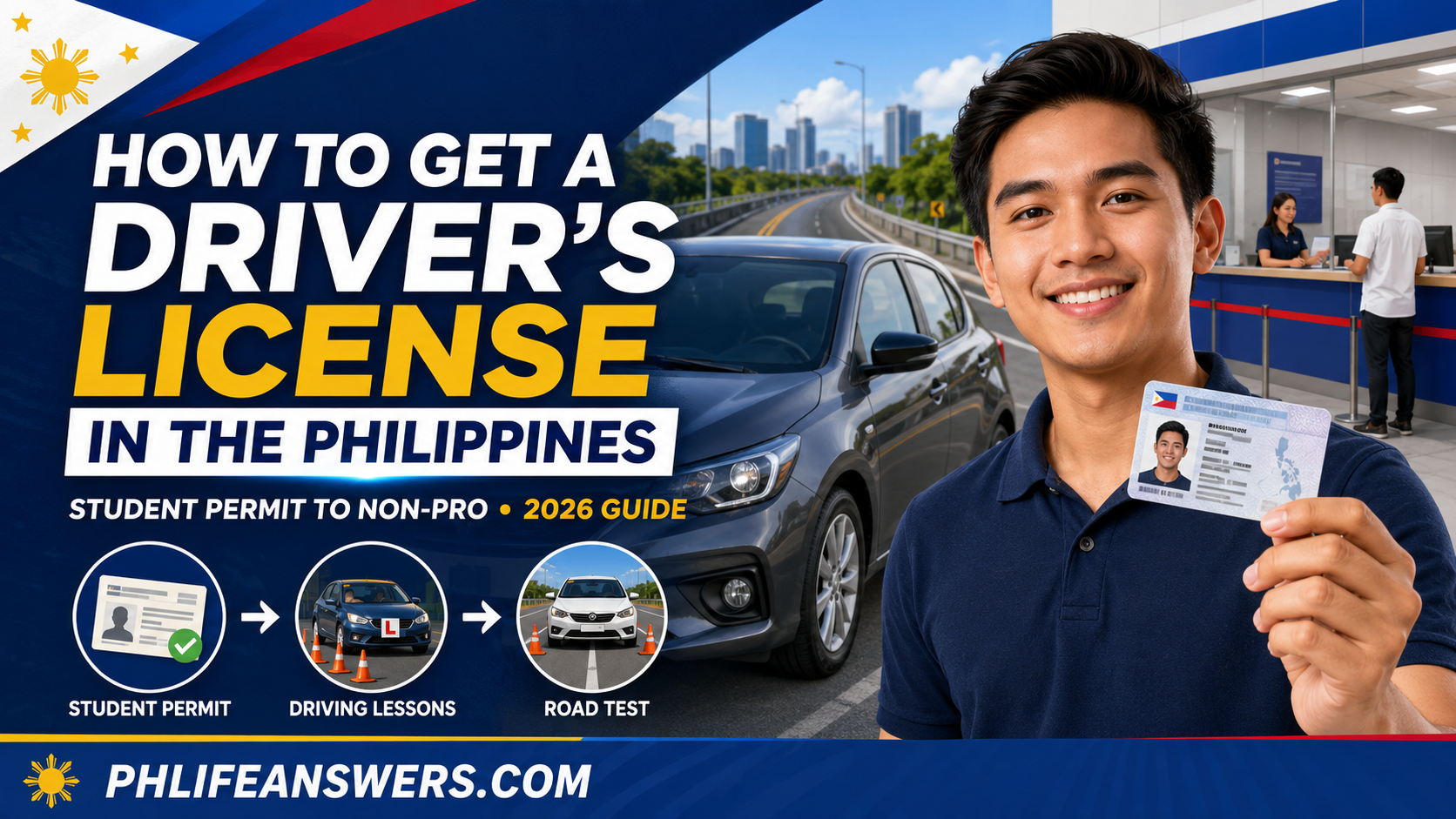
Getting your first driver’s license in the Philippines involves more than simply visiting an LTO office and taking an exam.
A first-time Filipino applicant must normally complete a Theoretical Driving Course, obtain a Student-Driver’s Permit, finish practical driving lessons, and pass both the written and practical examinations before receiving a Non-Professional Driver’s License.
This 2026 guide explains the entire process, including the requirements, fees, waiting period, medical examination, and common mistakes to avoid.
Important: This guide is intended for Filipino citizens applying for their first Philippine driver’s license. Foreign nationals and holders of foreign driver’s licenses may have different requirements.
Quick Overview of the Process
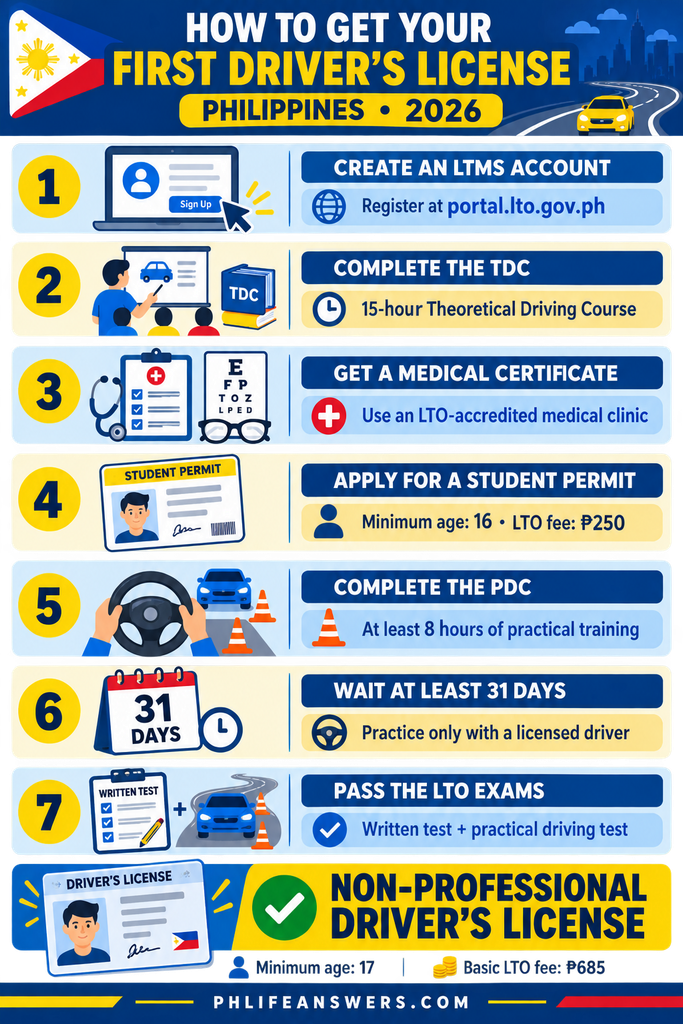
The usual process is:
- Create an LTMS Portal account.
- Complete the Theoretical Driving Course or TDC.
- Get a medical certificate from an LTO-accredited medical clinic.
- Apply for a Student-Driver’s Permit.
- Practice driving with a properly licensed driver.
- Complete the Practical Driving Course or PDC.
- Wait at least 31 days after the Student Permit was issued.
- Apply for a Non-Professional Driver’s License.
- Pass the LTO written and practical driving examinations.
- Pay the fees and receive the driver’s license.
The entire process cannot normally be completed in one day because the applicant must hold a Student Permit for at least 31 days before applying for a Non-Professional Driver’s License.
Step 1: Create an LTMS Portal Account
Before enrolling in a driving course or visiting an LTO licensing office, create an account through the official LTO LTMS Portal.
The LTMS Portal is used to manage your LTO client information and driving-related transactions.
When registering, make sure that your:
- Complete name matches your PSA birth certificate
- Birth date is correct
- Email address and mobile number are active
- Address and personal information are accurate
Avoid creating multiple LTMS accounts. Duplicate records can cause delays when the driving school or LTO office attempts to upload your certificates and application information.
Step 2: Complete the Theoretical Driving Course
All first-time Student Permit applicants must complete a Theoretical Driving Course or TDC.
The TDC consists of at least 15 hours of instruction covering topics such as:
- Philippine traffic laws
- Road signs and pavement markings
- Defensive driving
- Driver responsibilities
- Road courtesy
- Vehicle safety
- Emergency procedures
- Penalties and traffic violations
The course may be taken at:
- An LTO Driver Education Center
- An LTO-accredited driving school
- Participating local government programs
- An authorized Online Theoretical Driving Course provider, when available
Some LTO offices and local government units periodically offer free TDC programs. However, slots are limited and applicants normally need to register in advance.
After completing the course and passing the required assessment, the applicant receives a Certificate of Completion for the Theoretical Driving Course.
Make sure the driving school or training provider is officially accredited by LTO before paying.
Step 3: Get an LTO Medical Certificate
Applicants must undergo a medical examination at an LTO-accredited medical clinic.
The examination typically includes:
- Vision testing
- Hearing assessment
- Blood pressure check
- Basic physical examination
- Medical history review
- Assessment of physical and mental fitness to drive
Bring at least one valid government-issued ID and your LTMS Client ID.
The clinic should electronically transmit the medical certificate to the LTO system. A certificate from an unauthorized clinic may not be accepted, even if it appears to be a regular medical certificate.
How to Find an LTO-Accredited Medical Clinic
Applicants can check the official LTO Medical Clinics directory or ask the LTO licensing office where they plan to apply.
Before undergoing the examination, confirm that:
- The clinic’s LTO accreditation is still active
- The clinic can electronically transmit the result
- Your name and LTMS Client ID are entered correctly
- You will receive a printed copy or reference number
Do not automatically trust people offering medical certificates outside an LTO office. Verify the clinic directly to avoid fake or unregistered medical records.
Step 4: Apply for a Student-Driver’s Permit
A Filipino citizen may generally apply for a Student-Driver’s Permit at 16 years old, provided that the applicant is physically and mentally fit and can read and write in Filipino, English, or an applicable local dialect.
Student Permit Requirements
Prepare the following:
- Accomplished Application for Permits and License form
- Original and photocopy of a PSA birth certificate
- One valid government-issued ID
- Theoretical Driving Course certificate
- Electronically transmitted medical certificate
- LTMS Client ID
- Parent or guardian’s consent if the applicant is below 18
- Valid ID of the consenting parent or guardian
LTO may request additional documents if the applicant’s name, birth date, address, or other personal information does not match the records in the system.
Student Permit Fee
According to the LTO 2026 Citizen’s Charter, the basic LTO fees for a new Student-Driver’s Permit total approximately:
| Fee | Amount |
|---|---|
| Application fee | ₱100 |
| Student Permit fee | ₱150 |
| Total LTO fee | ₱250 |
This does not include the cost of the TDC, medical examination, photocopies, transportation, or other personal expenses.
Is a Student Permit Already a Driver’s License?
No. A Student-Driver’s Permit is not a full driver’s license.
A permit holder may practice driving only when accompanied by a person who holds a valid driver’s license with the appropriate vehicle category.
Driving alone with only a Student Permit may result in penalties.
The Student Permit is valid for one year from its date of issuance. However, it can generally be used to apply for a Non-Professional Driver’s License only after the required waiting period and while the permit remains eligible for the transaction.
Step 5: Complete the Practical Driving Course
After receiving the Student Permit, enroll in a Practical Driving Course or PDC at an LTO-accredited driving school.
The course must cover the type of vehicle the applicant intends to drive, such as:
- Motorcycle
- Manual-transmission car
- Automatic-transmission car
The PDC usually includes at least eight hours of practical driving instruction.
Training commonly covers:
- Pre-driving vehicle inspection
- Proper steering and braking
- Starting and stopping
- Turning and lane changing
- Parking
- Reversing
- Driving in traffic
- Defensive driving techniques
- Observing road signs and traffic rules
After completing the course and passing the driving school’s assessment, the applicant receives a Practical Driving Course certificate.
Verify that the certificate has been properly uploaded or encoded in the LTO system.
Step 6: Wait at Least 31 Days
A Filipino Student Permit holder must generally wait at least 31 days from the permit’s issuance date before applying for a Non-Professional Driver’s License.
For example, if the Student Permit was issued on August 1, the applicant should confirm the eligible application date before visiting LTO in September.
Completing the PDC early does not remove the mandatory waiting period.
Use this time to practice with a properly licensed driver and review the LTO examination topics.
Step 7: Apply for a Non-Professional Driver’s License
A Filipino applicant must generally be at least 17 years old to apply for a Non-Professional Driver’s License.
The applicant must also be physically and mentally fit, able to read and write, and free from unsettled traffic violations.
New Non-Professional License Requirements
Prepare the following documents:
- Accomplished Application for Permits and License form
- Original Student-Driver’s Permit
- Practical Driving Course certificate
- Valid electronically transmitted medical certificate
- Valid government-issued ID
- LTMS Client ID
- Other supporting documents requested by LTO
Check the spelling of your name and all personal details before submitting the application.
Step 8: Take the LTO Written Examination
The applicant must pass the LTO theoretical or written driving examination.
The examination covers topics such as:
- Traffic signs
- Road markings
- Right-of-way rules
- Parking rules
- Speed limits
- Driver responsibilities
- Road safety
- Traffic violations and penalties
- Proper actions during emergencies
Review the official LTO Driver’s Manual and the materials from your TDC before taking the exam.
Do not rely entirely on memorized online answer keys. The wording and order of questions may change, and understanding the rules is essential for the practical examination and actual driving.
If the applicant fails the written examination, LTO may require the applicant to return on another date, subject to its retake rules.
Step 9: Pass the Practical Driving Examination
After passing the written examination, the applicant must complete a practical driving test.
An LTO evaluator will assess whether the applicant can safely operate the selected vehicle.
The evaluator may check:
- Seat and mirror adjustment
- Seat belt or helmet use
- Starting and stopping
- Steering and vehicle control
- Use of signals
- Turning and lane positioning
- Reversing
- Parking
- Compliance with traffic signs
- Awareness of other road users
Some LTO offices have a testing vehicle available for a separate rental fee. Other locations may require or allow the applicant to provide an appropriate registered vehicle.
Confirm the vehicle arrangement with the chosen LTO office before the application date.
Step 10: Pay the Fees and Receive the License
The standard basic LTO fees for a new Non-Professional Driver’s License are commonly:
| Fee | Amount |
| Application fee | ₱100 |
| License fee | ₱585 |
| Basic LTO total | ₱685 |
Additional costs may apply for vehicle rental, examinations, document corrections, or other services.
After passing the examinations and completing the payment, review all information printed on the official receipt and driver’s license.
Check the:
- Full name
- Birth date
- Address
- Driver’s license number
- Vehicle codes or categories
- License validity
Report any mistake before leaving the LTO office.
A first-time driver will normally receive a license with a five-year validity period. A 10-year license is generally available during a future renewal to qualified drivers with no recorded traffic violations during the relevant period.
Estimated Total Cost
The actual total depends on the driving school, clinic, location, and type of vehicle.
| Expense | Estimated Cost |
| Theoretical Driving Course | Free to around ₱5,000 |
| Medical examination | Around ₱400–₱700 |
| Student Permit LTO fees | ₱250 |
| Practical Driving Course | Around ₱2,500–₱8,000 or more |
| New license LTO fees | ₱685 |
| Practical test vehicle rental | Varies |
| Possible total | Approximately ₱3,835–₱14,635 or more |
These are estimates. Always request an official receipt and verify the latest fees directly with LTO or the accredited service provider.
Common Mistakes to Avoid
Using a Non-Accredited Driving School
A cheap TDC or PDC certificate may be useless if the provider is not accredited or cannot upload the certificate to the LTO system.
Getting a Medical Certificate From an Unauthorized Clinic
Only use a clinic with active LTO accreditation and electronic submission capability.
Creating Multiple LTMS Accounts
Duplicate accounts can result in mismatched records and delayed transactions.
Applying Before the 31-Day Waiting Period
LTO may reject or postpone the application if the minimum holding period has not been completed.
Choosing the Wrong Vehicle Category
Complete the PDC and practical examination using the correct motorcycle, manual car, or automatic car category needed for your intended vehicle.
Driving Alone With a Student Permit
A Student Permit does not authorize independent driving. A properly licensed driver must accompany the student.
Paying a Fixer
Applicants should deal only with official LTO personnel, accredited schools, and accredited clinics. Fixers may provide fake documents, cause record problems, or expose the applicant to criminal and administrative penalties.
Frequently Asked Questions
Can I get a Philippine driver’s license without attending a driving school?
The required TDC and PDC must be completed through an authorized or LTO-accredited provider. Some LTO Driver Education Centers and LGUs offer free courses, but the required certificates must still be properly issued and recorded.
How old must I be to get a Student Permit?
A Filipino citizen may generally apply for a Student-Driver’s Permit at 16 years old.
How old must I be to get a Non-Professional Driver’s License?
A Filipino applicant must generally be at least 17 years old.
How long must I hold a Student Permit?
You must generally hold the Student Permit for at least 31 days before applying for a Non-Professional Driver’s License.
Can I drive alone using a Student Permit?
No. You must be accompanied by a properly licensed driver who is authorized to operate the same type of vehicle.
How long is a Student Permit valid?
A Student Permit is valid for one year from its issuance date. Do not wait until the last minute to complete the practical course and license application.
Is the LTO medical examination available at any clinic?
No. The medical certificate must come from an LTO-accredited clinic and must be electronically transmitted to the LTO system.
Can I take the TDC for free?
Yes, some LTO Driver Education Centers and local government programs offer free TDC classes. Availability and registration schedules depend on the location.
Is the CDE exam required for a first-time license?
The Comprehensive Driver’s Education or CDE validation exam is mainly associated with driver’s license renewal. First-time applicants complete the TDC and must pass the required LTO theoretical examination for a new license.
What happens if I fail the LTO examination?
You may be allowed to retake the examination according to LTO’s applicable rules and waiting periods. Ask the licensing office for the exact return date and do not pay anyone who promises a guaranteed passing result.
Final Reminder
The safest way to obtain a Philippine driver’s license is to follow the official process:
TDC → Medical Certificate → Student Permit → PDC → 31-Day Waiting Period → Written Exam → Practical Exam → Non-Professional Driver’s License
Requirements and office procedures can change. Before visiting, check the official Land Transportation Office website, the LTMS Portal, or contact the specific LTO licensing office where you plan to apply.
Last updated: August 2026.