Anyone living in the Philippines has probably experienced the same unpleasant surprise: the electricity bill arrives, and it is much higher than expected.
For Filipino families, renters, small businesses and even large companies, electricity is one of the most noticeable monthly expenses.
And this is not simply a matter of perception.
In June 2026, the Philippines recorded an average nationwide electricity rate of ₱12.43 per kilowatt-hour (kWh). According to the Department of Energy (DOE), that was the highest average rate among Southeast Asian countries for that month.
For customers served by Meralco, the figure can be even higher.
In September 2026, Meralco’s overall residential electricity rate stood at ₱14.7424 per kWh.
So why is electricity so expensive in the Philippines?
The answer is more complicated than simply blaming Meralco.
The country’s electricity bill reflects the cost of generating power, imported fuel, exchange rates, transmission infrastructure, power plant outages, taxes, system losses and several other charges.
Let’s break it down.
How Expensive Is Electricity in the Philippines?
The Philippines has long had some of the highest electricity prices in Southeast Asia.
A World Bank assessment using July 2024 data found that the Philippines had the second-highest average electricity tariff in ASEAN after Singapore.
By June 2026, the situation had temporarily become even more striking.
DOE data showed that the country’s nationwide average electricity rate reached approximately:
₱12.43/kWh
during June 2026 — slightly higher than Singapore for that particular month.
It is important to understand that this was a nationwide monthly comparison, not a claim that the Philippines permanently has the highest electricity rate in ASEAN.
Electricity prices change every month and vary significantly depending on location and distribution utility.
Metro Manila and many nearby provinces are primarily served by Meralco.
For September 2026, Meralco announced an overall residential rate of:
₱14.7424/kWh
That means a household consuming 200 kWh would face an electricity charge of roughly ₱2,948 before considering differences in individual billing circumstances.
Where Does Your Meralco Bill Actually Go?
One common misunderstanding is that the entire electricity bill goes to Meralco.
It does not.
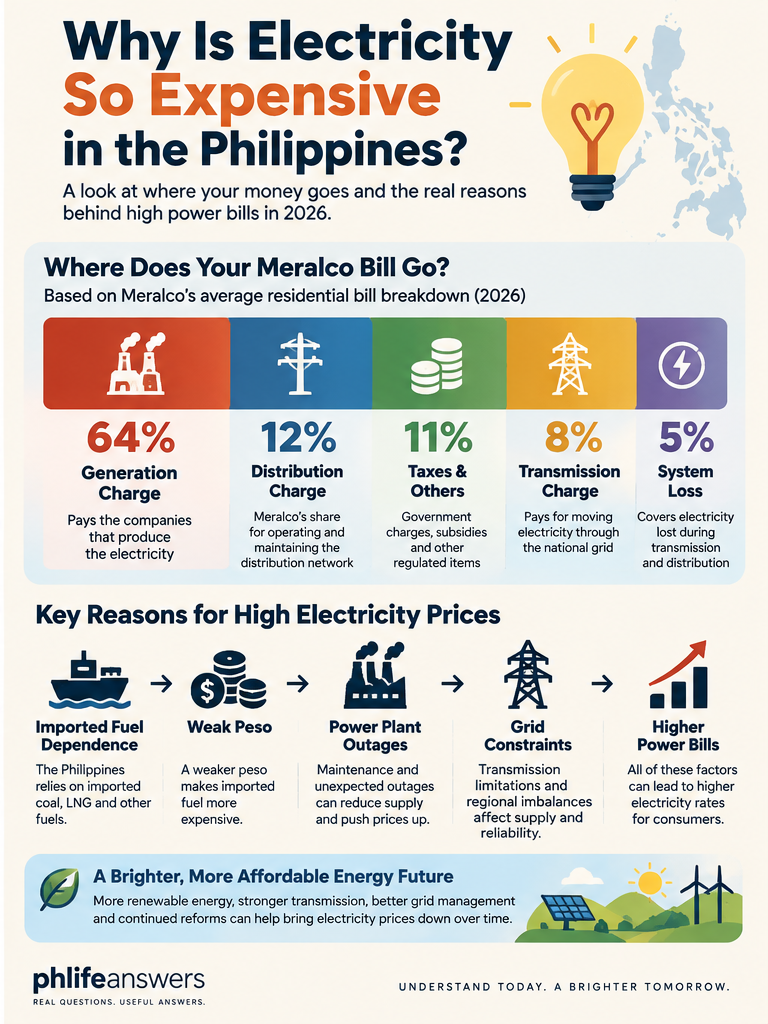
Based on Meralco’s average bill breakdown, updated in 2026, approximately:
64% — Generation Charge
This pays the companies that actually produce the electricity.
12% — Distribution Charge
This is the portion that goes to Meralco for operating and maintaining its distribution network, meters, billing systems and customer service.
11% — Taxes, subsidies and other charges
These include government-mandated charges and other regulated items.
8% — Transmission Charge
This primarily pays for moving electricity from power plants through the national transmission grid.
5% — System Loss
This covers electricity lost while being transmitted and distributed, within limits regulated by the government.
In other words, around 88% of an average Meralco bill consists of pass-through charges that Meralco collects and then remits to power generators, the transmission operator, government agencies and other entities.
This distinction is important because the largest component of the electricity bill is not the distribution charge.
It is the cost of generating electricity itself.
1. Electricity Generation Is Expensive
Generation accounts for the largest part of the electricity bill.
And electricity generation in the Philippines remains highly exposed to fuel prices.
The country still relies heavily on thermal power generation, particularly coal and natural gas.
When the price of coal, LNG or other fuels rises internationally, electricity generation costs can rise as well.
The Philippines is particularly vulnerable because a significant portion of its fuel requirements comes from overseas.
That means Filipino consumers can indirectly feel the impact of events happening thousands of kilometers away.
War, geopolitical tensions, shipping disruptions or higher global energy demand can eventually appear in your monthly electricity bill.
2. The Peso-Dollar Exchange Rate Matters
There is another problem.
Imported fuel is generally purchased using foreign currency.
If the Philippine peso weakens against the US dollar, importing the same amount of fuel becomes more expensive in peso terms.
This is one reason electricity rates can increase even when Filipino households have not changed their electricity consumption.
Meralco specifically cited higher fuel costs and a weaker peso as factors contributing to higher generation charges in September 2026.
This exposes Philippine consumers to two risks at the same time:
global fuel prices + foreign exchange movements.
3. Power Plant Outages Can Quickly Push Prices Higher
The Philippines may have enough generating capacity on paper, but that does not mean every power plant is available every day.
Power stations require maintenance.
Some experience unexpected breakdowns.
Others may be temporarily unavailable because of fuel, technical or transmission problems.
This became particularly visible in the Visayas in 2026.
According to the DOE, 21 power plants were on forced outage during a period of severe supply constraints in the Visayas.
The region consequently became more dependent on electricity transferred from Luzon and Mindanao.
When available electricity supply becomes tight while demand remains high, more expensive power sources may need to operate.
Wholesale electricity prices can then rise.
And ultimately, those costs can reach consumers.
4. So Does the Philippines Actually Have a Power Shortage?
This requires some clarification.
The Philippines does not simply “run out of electricity” nationwide every day.
The bigger problem is reliability and reserve capacity.
The electricity grid needs more power available than consumers are actually using at any given moment.
That extra capacity acts as a safety buffer if a major power station suddenly goes offline.
When that reserve becomes too small, the National Grid Corporation of the Philippines may issue a:
Yellow Alert — reserves have fallen below the required level.
A more serious Red Alert can occur when available supply becomes insufficient to meet demand and required reserves.
Several incidents during 2026 demonstrated the vulnerability of the system.
In April, consecutive outages involving generating units resulted in a Yellow Alert in Luzon.
In May, transmission problems involving the Ilijan power complex contributed to a Red Alert in Luzon and Yellow Alert in the Visayas.
And as recently as September 2026, the DOE was still working to restore generating units in the Visayas and strengthen reserves to reduce the risk of recurring Yellow and Red Alerts.
So the issue is not simply:
“The Philippines does not have enough power plants.”
It is better described as a combination of:
generation availability, reserve margins, transmission capacity and regional supply imbalances.
5. The Philippines Is an Archipelago — and That Matters
Electricity infrastructure is more complicated in a country consisting of more than 7,000 islands.
Electricity generated in one area cannot always easily be moved to another area where it is needed.
Luzon, Visayas and Mindanao are increasingly interconnected, but transmission infrastructure remains extremely important.
A transmission failure can prevent electricity from reaching consumers even when the generating capacity itself still exists.
The May 2026 Ilijan incident demonstrated exactly this problem.
DOE reported that transmission-line trips isolated the Ilijan gas-to-power complex from the Luzon grid, contributing to emergency alerts affecting Luzon and the Visayas.
This demonstrates why building power plants alone cannot solve the country’s electricity problem.
The Philippines also needs significant investment in:
transmission lines, substations, inter-island connections, energy storage and grid modernization.
6. The Wholesale Electricity Spot Market Can Affect Prices
Some electricity is purchased through long-term Power Supply Agreements.
But electricity can also be purchased through the Wholesale Electricity Spot Market, or WESM.
Think of WESM as a marketplace where electricity prices can change according to real-time supply and demand conditions.
When electricity supply is plentiful, prices may be relatively low.
But when demand is high and several power plants are unavailable, spot prices can rise sharply.
Distribution utilities that need to purchase more electricity from the spot market during expensive periods can therefore face higher generation costs.
Those costs can eventually be reflected in consumers’ bills.
7. Taxes and Other Regulated Charges Also Add to the Bill
Generation is the largest expense, but it is not the only one.
Electricity bills also include various regulated charges involving transmission, system loss, taxes and government programs.
This makes Philippine electricity pricing structurally different from countries where governments heavily subsidize electricity.
The World Bank has specifically noted that differences in electricity prices across ASEAN countries are partly influenced by government subsidies or the lack of them.
That is an important point when comparing the Philippines directly with countries such as Indonesia, Malaysia or Vietnam.
A lower consumer electricity price does not necessarily mean electricity is cheaper to produce.
In some countries, part of the cost is absorbed by the government instead of appearing directly in the consumer’s monthly bill.
Why High Electricity Prices Affect More Than Your Meralco Bill
Expensive electricity is not just a household utility problem.
Almost every business uses electricity.
Restaurants need refrigerators and air-conditioning.
Shopping malls require lighting and cooling.
Factories run machinery.
Data centers operate servers.
Hotels use enormous amounts of electricity.
Water suppliers, supermarkets, warehouses and transportation systems all depend on energy.
When those businesses pay higher electricity bills, part of those additional costs can eventually be reflected in the prices consumers pay.
This is why electricity prices affect the broader cost of living in the Philippines.
The World Bank has described lowering electricity costs as an important way to improve both household living standards and Philippine business competitiveness.
Can Renewable Energy Lower Electricity Prices?
Potentially, yes — but renewable energy alone is not a magic solution.
Solar, wind, hydro and geothermal energy can reduce the country’s dependence on imported fossil fuels.
Once solar and wind facilities are operating, they do not need to continuously purchase coal or LNG from international markets.
That reduces exposure to global fuel-price shocks.
The Philippine government is targeting renewable energy to account for 35% of the country’s power generation mix by 2030 and 50% by 2040.
The World Bank estimates that reaching the 35% renewable-energy target by 2030, together with improvements in transmission, storage, grid flexibility and electricity-market competition, could significantly reduce residential electricity prices.
But renewables require supporting infrastructure.
Solar generation falls at night.
Wind generation varies according to weather conditions.
That means the country also needs:
battery storage, stronger transmission infrastructure, flexible generation and better grid management.
Will Electricity Become Cheaper?
There are reasons to be cautiously optimistic.
More solar and wind projects are being developed.
Battery energy storage is expanding.
Transmission infrastructure is improving.
Consumers are gradually receiving more options to choose electricity suppliers.
The government is also simplifying rules for rooftop solar and encouraging households and businesses to generate some of their own electricity.
But electricity prices are unlikely to fall dramatically overnight.
The Philippines still faces structural challenges involving imported fuel dependence, infrastructure investment, power plant reliability and a rapidly growing demand for electricity.
The Bottom Line
The Philippines’ expensive electricity cannot be blamed on one company or one problem.
It is the result of an entire electricity system.
The biggest component of the average Meralco bill is the generation charge, while international fuel prices, the peso-dollar exchange rate, power plant outages, transmission constraints, taxes and reserve shortages can all influence what consumers eventually pay.
And when electricity becomes expensive, the impact spreads far beyond the monthly power bill.
It affects businesses.
It affects food prices.
It affects jobs.
And ultimately, it affects the everyday cost of living for millions of Filipinos.
That is why solving the Philippines’ electricity problem is not simply an energy issue.
It is an economic and household cost-of-living issue.
Learn how to read your Meralco bill and understand each charge
1 thought on “Why Is Electricity So Expensive in the Philippines? The Real Reasons Behind High Power Bills in 2026”