
If you live or work in the Philippines, you have probably heard of PhilHealth. Employees see it deducted from their salary, employers are required to remit contributions, and self-employed Filipinos may pay their contributions directly.
But what exactly does PhilHealth cover? How much does it cost? And does paying a higher contribution mean receiving better benefits?
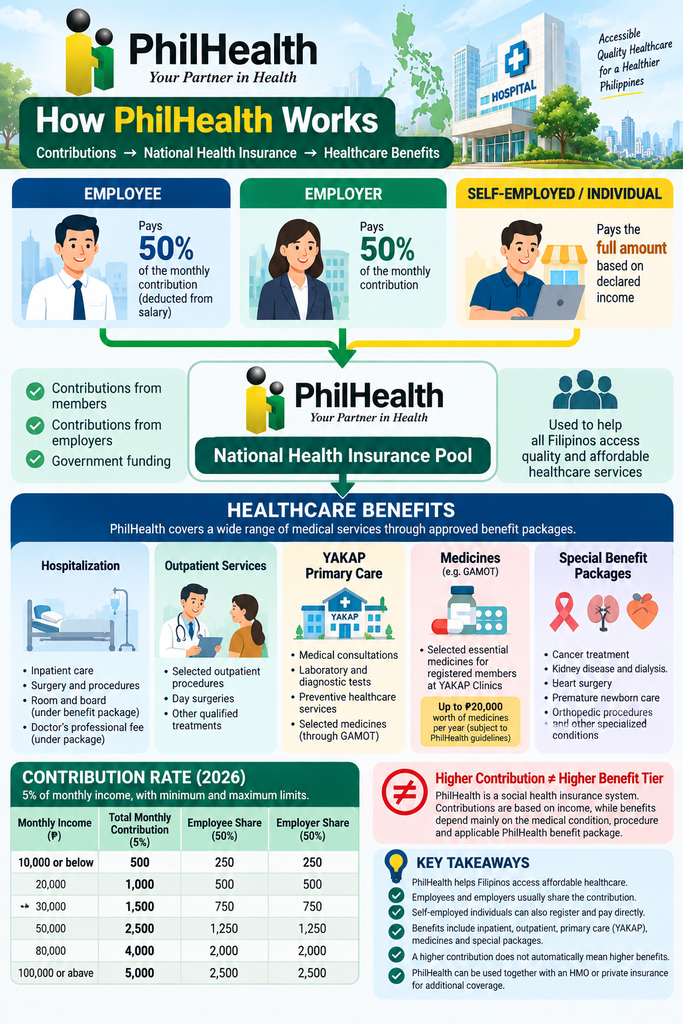
Here is a simple overview of how PhilHealth works in the Philippines.
What Is PhilHealth?
The Philippine Health Insurance Corporation (PhilHealth) is the government corporation responsible for administering the country’s National Health Insurance Program (NHIP).
Its purpose is to help Filipinos access healthcare without having to shoulder the entire cost themselves.
PhilHealth operates as a social health insurance system. In simple terms, contributions from members, employers and government funding are pooled together to help finance healthcare services for the population.
Unlike a private insurance company, PhilHealth does not operate hospitals or directly provide medical treatment. Instead, it pays or reimburses accredited healthcare providers according to approved benefit packages.
A Short History of PhilHealth
The Philippines already had a government Medicare system before PhilHealth existed.
The Philippine Medical Care Act was enacted in 1969, and the Medicare program began operating in the early 1970s.
The modern PhilHealth system was created through Republic Act No. 7875, or the National Health Insurance Act of 1995.
PhilHealth gradually took over Medicare functions for government employees in 1997 and private-sector employees in 1998.
Another major change came with the Universal Health Care Act (RA 11223) in 2019, which moved the Philippines toward automatic health insurance coverage for Filipinos and immediate eligibility for PhilHealth benefits.
How Much Is the PhilHealth Contribution?
For direct contributors, the current premium structure has reached a 5% contribution rate, using an income floor of ₱10,000 and an income ceiling of ₱100,000.
This means the contribution generally ranges from:
| Monthly Income | Total Monthly PhilHealth Contribution |
|---|---|
| ₱10,000 or below | ₱500 |
| ₱20,000 | ₱1,000 |
| ₱30,000 | ₱1,500 |
| ₱50,000 | ₱2,500 |
| ₱80,000 | ₱4,000 |
| ₱100,000 or above | ₱5,000 |
For employees, this amount is normally divided equally between the employee and employer.
For example, an employee earning ₱30,000 per month has a total monthly premium of ₱1,500.
Employee: ₱750
Employer: ₱750
Total remitted to PhilHealth: ₱1,500
Self-employed or self-paying members generally shoulder their own contribution based on their declared income.
Does Paying More Give You More Benefits?
This is one of the most misunderstood parts of PhilHealth.
Generally, no.
PhilHealth is not structured like private health insurance where paying for a more expensive plan gives you a higher room limit, larger annual coverage or a premium insurance tier.
A person earning ₱20,000 may contribute less than someone earning ₱100,000, but this does not automatically mean the higher-income member receives five times more hospital coverage.
PhilHealth benefits are generally determined by the medical condition, treatment, procedure and applicable PhilHealth benefit package, rather than simply by how much the individual member contributed.
This reflects the basic principle of social health insurance: people contribute according to their capacity, while benefits are primarily based on healthcare needs and established benefit packages.
What Does PhilHealth Cover?
PhilHealth coverage is much broader than just hospital confinement.
Hospitalization
For inpatient treatment, PhilHealth uses benefit packages such as All Case Rates, where an approved amount is deducted from the patient’s hospital bill.
The amount depends on the illness, procedure or treatment involved.
Hospital charges and professional fees may be included within the applicable package.
Outpatient Services
Certain medical procedures can be covered without hospital admission, including qualified day surgeries and other outpatient treatments.
Primary Care – YAKAP
PhilHealth has significantly expanded primary and preventive healthcare through its YAKAP (Yaman ng Kalusugan) Program.
Members registered with a YAKAP Clinic may access services such as medical consultations, selected laboratory and diagnostic tests, preventive healthcare services and medicines under applicable PhilHealth programs.
Serious and High-Cost Diseases
PhilHealth also provides special benefit packages for certain serious illnesses and expensive treatments.
These include selected packages involving cancer, kidney disease and dialysis, heart surgery, premature newborn care, orthopedic treatment and other specialized conditions.
Coverage depends on the specific disease, treatment and accredited healthcare provider.
PhilHealth for Employees
For most regularly employed workers, PhilHealth administration is relatively simple.
The employee provides their PhilHealth Identification Number (PIN) to the employer.
The employer then:
- Calculates the required contribution.
- Deducts the employee’s share from salary.
- Adds the employer’s share.
- Remits the total contribution to PhilHealth.
Employees should still periodically check their PhilHealth records to make sure contributions are actually being remitted correctly.
PhilHealth for Self-Employed Individuals
Freelancers, professionals, business owners and other self-earning individuals can register as self-paying members.
Unlike employees, there is no employer paying half of the contribution.
The member normally declares income and pays the required premium directly to PhilHealth.
Depending on the applicable rules, payments may be made monthly or for longer periods such as quarterly, semi-annually or annually.
PhilHealth for Employers
For employers, PhilHealth is not simply an optional employee benefit.
Employers are responsible for registering eligible employees, correctly calculating contributions, deducting the employee portion, paying the corresponding employer portion and remitting contributions within PhilHealth’s required deadlines.
Failure to properly remit contributions can create liabilities for the employer.
For a business owner with employees in the Philippines, PhilHealth should therefore be treated as part of regular payroll compliance together with other mandatory government contributions.
Is PhilHealth Enough as Health Insurance?
PhilHealth provides an important financial safety net, but it should not automatically be considered a complete replacement for private medical insurance or an HMO.
Depending on the hospital, illness and treatment, the actual medical bill may be significantly higher than the amount covered by PhilHealth.
A useful way to think about the Philippine healthcare system is:
PhilHealth = Basic national health insurance
HMO = Additional everyday/private healthcare coverage
Private Medical Insurance = Additional protection against potentially large medical expenses
These systems can complement each other rather than necessarily replace one another.
The Bottom Line
PhilHealth is the foundation of the Philippines’ national health insurance system.
Employees and employers generally share contributions, while self-employed members normally pay their own premiums. Contributions are linked to income, but higher contributions do not automatically purchase higher levels of PhilHealth coverage.
The actual benefit depends primarily on the medical service, illness or procedure and the corresponding PhilHealth benefit package.
For employees, understanding PhilHealth helps you check whether your mandatory contributions are being properly remitted.
For employers, understanding the system is an important part of payroll and labor compliance.
And for individuals and families, knowing what PhilHealth actually covers — and what it does not — can make a significant difference when planning for healthcare expenses in the Philippines.
FAQ
1. How much is the PhilHealth contribution in 2026?
For direct contributors, the PhilHealth premium rate is 5% of the applicable monthly income, subject to the current minimum and maximum income limits. For employees, the contribution is generally shared equally between the employee and employer.
2. Does paying a higher PhilHealth contribution give you higher benefits?
Not necessarily. PhilHealth is a social health insurance system. Contributions are generally based on income, while benefits depend primarily on the medical condition, procedure and applicable PhilHealth benefit package.
3. How much does an employer pay for PhilHealth?
For formally employed members, the required PhilHealth premium is generally divided equally between the employer and employee.
4. Can self-employed people have PhilHealth?
Yes. Freelancers, professionals, business owners and other self-earning individuals can register with PhilHealth and pay their own required contributions.
5. Is PhilHealth enough without private health insurance?
PhilHealth provides basic national health insurance protection, but it may not cover the entire medical bill. Some people therefore use PhilHealth together with an HMO or private medical insurance.