
Last updated: October 3, 2026
If you pay PhilHealth contributions every month, you may still have one very basic question:
How much will PhilHealth actually pay when I get sick or go to the hospital?
The answer is not “50% of your bill” or “80% of your bill.”
For many illnesses and procedures, PhilHealth uses case rates and benefit packages. This means PhilHealth assigns a specific benefit amount depending on the diagnosis, treatment or medical procedure.
For example, current benefit amounts include ₱29,250 for moderate-risk pneumonia, up to ₱47,000 for severe dengue, ₱58,000 for a medically indicated primary Cesarean section, ₱6,350 per hemodialysis session, and up to ₱1.4 million for eligible breast cancer treatment. PhilHealth
But understanding those numbers requires one important distinction:
A PhilHealth package rate is not always the same thing as the amount you personally save on the final hospital bill.
Your actual out-of-pocket expense can depend on the benefit package, accommodation type, accredited facility, additional services, HMO coverage and other applicable rules.
Let us look at how it really works.
How PhilHealth Coverage Actually Works
For many inpatient cases, PhilHealth pays accredited healthcare facilities through the All Case Rates (ACR) system.
The applicable case rate is deducted from the patient’s hospital bill and generally includes both hospital charges and the professional fees of attending physicians. PhilHealth
This is very different from a private insurance plan that simply promises to pay a fixed percentage of your bill.
For example, two people could both be admitted for the same covered condition:
Patient A hospital bill: ₱55,000
Patient B hospital bill: ₱80,000
If the same PhilHealth case rate applies to both patients, PhilHealth does not automatically pay more simply because Patient B’s hospital charged more.
This is why knowing the applicable case rate or benefit package is more useful than asking, “What percentage does PhilHealth cover?”
Real PhilHealth Benefit Amounts in 2026
Here are several examples based on current PhilHealth benefit rules and official announcements.
| Condition / Treatment | PhilHealth Benefit | Notes |
|---|---|---|
| Moderate-risk pneumonia | ₱29,250 | Inpatient case rate |
| Mild dengue | ₱19,500 | Hospitalization benefit |
| Severe dengue | Up to ₱47,000 | Depending on qualifying diagnosis |
| Gallbladder removal / Cholecystectomy | ₱60,450 | Procedure case rate |
| Normal vaginal delivery, hospital | ₱29,000 | 2026 maternity package |
| Primary Cesarean Section | ₱58,000 | Must be medically indicated |
| Hemodialysis | ₱6,350/session | Up to 156 sessions/year for qualified CKD5 patients |
| Breast cancer | Up to ₱1.4 million | Z Benefit, eligibility applies |
| Heart attack — PCI | About ₱524,000 | Percutaneous coronary intervention |
| YAKAP/GAMOT medicines | Up to ₱20,000/year | Eligible medicines through participating facilities |
Quick visual guide: The infographic below summarizes several major PhilHealth benefit amounts in 2026, including pneumonia, severe dengue, C-section, dialysis, heart attack PCI and breast cancer.
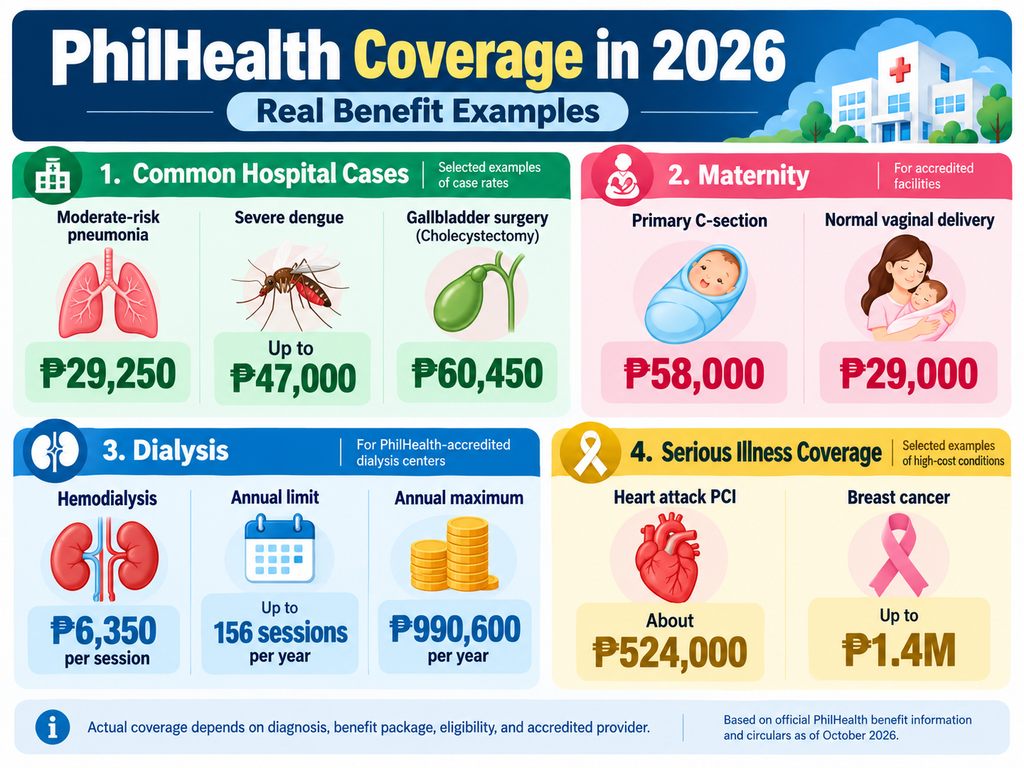
These amounts are examples of current benefit packages. Actual coverage depends on diagnosis, eligibility, accredited provider and the applicable PhilHealth rules.
PhilHealth increased thousands of case rates beginning in 2025. Moderate-risk pneumonia, for example, increased to ₱29,250, while cholecystectomy increased to ₱60,450. PhilHealth
For dengue, current coverage is ₱19,500 for mild cases and as much as ₱47,000 for severe dengue. PhilHealth
Example 1: A ₱70,000 Pneumonia Hospital Bill
Suppose a patient is admitted with a diagnosis that qualifies for the ₱29,250 moderate-risk pneumonia case rate.
A simplified calculation looks like this:
Hospital charges: ₱70,000
PhilHealth case rate: − ₱29,250
Remaining amount: ₱40,750
However, this is only a simplified illustration.
The ₱40,750 does not automatically mean the patient must personally pay the entire amount.
Other benefits may apply, including:
- HMO coverage
- Employer medical benefits
- Private insurance
- Senior citizen or PWD benefits where applicable
- No co-payment rules applying to certain packages
This distinction is important when comparing PhilHealth benefits with the final amount appearing on a hospital statement.
Example 2: Dengue Hospitalization
Dengue is one of the most common conditions claimed under PhilHealth.
PhilHealth currently provides:
Mild dengue: ₱19,500
Severe dengue: up to ₱47,000
PhilHealth reported that these amounts were increased from the previous ₱10,000 and ₱16,000 benefit levels respectively. PhilHealth
So if a patient is admitted with severe dengue, the benefit can be considerably larger than it was only a few years ago.
The exact classification must still be based on the patient’s medical diagnosis and claim documentation.
Example 3: Childbirth — This Is Where the Rules Become More Interesting
PhilHealth changed its maternity coverage again in 2026.
For hospital care, the current package rates include:
Normal Spontaneous Delivery: ₱29,000
Primary Cesarean Section: ₱58,000
Cesarean after attempted vaginal delivery following a previous C-section: ₱62,000. PhilHealth
But simply subtracting ₱58,000 from a C-section hospital bill can actually be misleading.
Why?
Because the 2026 rules state that PhilHealth beneficiaries admitted to basic or ward accommodation are entitled to no co-payment for services already covered under the package in both accredited public and private hospitals. PhilHealth
That includes covered items such as procedures, medicines, supplies and professional services.
Patients choosing upgraded accommodation or additional services outside the covered package may still incur additional expenses. PhilHealth
This means:
A woman using a basic/ward bed for a covered maternity service should not necessarily think:
“My bill is ₱100,000 minus ₱58,000, so I must pay ₱42,000.”
The actual charging rules may be much more favorable when the no-co-payment provisions apply.
This is one reason patients should ask the hospital’s PhilHealth desk before admission, especially for planned deliveries.
Example 4: Hemodialysis Can Reach Almost ₱1 Million a Year
PhilHealth’s hemodialysis benefit is one of its largest recurring benefits.
The current rate is:
₱6,350 per session
Qualified patients with Stage 5 Chronic Kidney Disease registered in the PhilHealth Dialysis Database can receive coverage for up to:
156 sessions per year.
That equals:
₱6,350 × 156 = ₱990,600 per year
in covered dialysis services. PhilHealth
PhilHealth’s rules also state that accredited public and private hemodialysis providers should not charge co-payment for the covered services included in the package. PhilHealth
This is a good example of why saying “PhilHealth only gives small hospital discounts” is no longer accurate.
For certain illnesses, the financial protection can be substantial.
PhilHealth Coverage for Cancer Can Exceed ₱1 Million
PhilHealth also operates Z Benefit Packages for serious or catastrophic illnesses.
One of the clearest examples is breast cancer.
The enhanced Z Benefit Package now provides coverage of:
Up to ₱1.4 million
for eligible breast cancer patients covering Stages 0 to IV, subject to PhilHealth eligibility rules and treatment at contracted facilities. PhilHealth
PhilHealth also maintains Z Benefit programs for other serious conditions, including selected cancers, kidney transplantation, heart surgery and other high-cost treatments. The list of contracted providers was still being actively maintained as of August 2026. PhilHealth
This is particularly important because Z Benefits may only be available through contracted healthcare facilities, not simply any hospital.
Heart Attack Treatment: More Than ₱500,000 for PCI
Another major expansion involves treatment for acute myocardial infarction — commonly called a heart attack.
PhilHealth’s benefit for Percutaneous Coronary Intervention (PCI), or coronary angioplasty, increased from approximately ₱30,300 to about:
₱524,000
PhilHealth also provides separate packages for fibrinolysis, emergency transfer and cardiac rehabilitation. PhilHealth
This shows just how much PhilHealth coverage now varies by treatment.
A common illness may have a benefit worth tens of thousands of pesos, while a major cardiovascular procedure may receive several hundred thousand pesos.
PhilHealth Is No Longer Only About Hospital Bills
Another important change is the expansion of outpatient and preventive care.
Through YAKAP — Yaman ng Kalusugan Program, members can access primary care services including consultations, selected laboratory and diagnostic services, preventive care and medicines. PhilHealth
PhilHealth’s GAMOT program can provide eligible members and dependents with:
Up to ₱20,000 worth of medicines per year
through accredited participating facilities and pharmacies. PhilHealth
Importantly, the ₱20,000 annual limit applies separately to the member and qualified dependents under the program rules. PhilHealth
This means PhilHealth is increasingly becoming relevant before hospitalization occurs, not only after someone becomes seriously ill.
Does Paying More PhilHealth Contribution Give You More Benefits?
Generally, no.
Suppose:
Employee A earns ₱20,000/month
and
Employee B earns ₱100,000/month.
Employee B contributes more to PhilHealth because contributions are linked to income.
But if both patients qualify for the same medical benefit package, Employee B does not automatically receive a benefit five times larger.
PhilHealth benefits are primarily determined by:
**Diagnosis
- Procedure or treatment
- Benefit package
- Eligibility
- Accredited provider rules**
rather than simply by the amount of premium an individual contributes.
Why Do Some Patients Still Pay Large Hospital Bills?
This is where many people become confused.
Having PhilHealth does not mean every hospital expense automatically becomes free.
Out-of-pocket expenses may still arise because of:
- Private or upgraded rooms
- Services outside the PhilHealth package
- Medicines or procedures not covered
- Non-accredited providers
- Additional physician or hospital services outside applicable benefit rules
- Treatment that does not meet a particular package’s eligibility criteria
At the same time, patients should also understand that some PhilHealth packages specifically prohibit co-payment for covered services.
So the correct question is not simply:
“How much will PhilHealth deduct?”
A better question is:
“What package applies to me, what services are included, and is this package subject to no co-payment or a co-payment cap?”
That can make a very large difference in the final bill.
Can PhilHealth and an HMO Be Used Together?
Yes.
PhilHealth and an HMO are not necessarily substitutes.
For example, PhilHealth’s 2026 maternity rules state that PhilHealth benefits and applicable mandatory discounts are deducted before HMO, private health insurance or employee benefits are applied. PhilHealth
In practical terms, many patients use:
PhilHealth first
then:
HMO / private insurance / company health benefits
to help cover eligible remaining expenses.
That is why having both PhilHealth and an HMO can provide significantly broader protection than either one alone.
How to Check Exactly How Much PhilHealth Will Cover
PhilHealth has thousands of case rates and packages, so you should not rely on a random social media post or an outdated hospital chart.
PhilHealth provides an official Case Rates Search service where users can search compensable illnesses and procedures. PhilHealth Case Rates
Before a planned admission or procedure, ask the hospital’s PhilHealth desk these five questions:
- What PhilHealth case rate or benefit package applies to my diagnosis?
- What is the current package amount?
- Which services and professional fees are included?
- Does a no-co-payment or co-payment-cap rule apply?
- Will choosing a semi-private or private room increase my out-of-pocket expense?
That conversation can be much more useful than simply asking whether the hospital “accepts PhilHealth.”
So, How Much Does PhilHealth Really Cover?
There is no single answer such as “PhilHealth pays 50%.”
Instead, coverage depends on the illness or procedure.
Current examples range from:
₱19,500 for mild dengue,
to ₱29,250 for moderate-risk pneumonia,
₱58,000 for primary Cesarean section,
up to ₱990,600 per year for qualified hemodialysis patients,
about ₱524,000 for heart attack PCI,
and up to ₱1.4 million for eligible breast cancer treatment. PhilHealth
The important thing to remember is:
PhilHealth does not normally reimburse a fixed percentage of your hospital bill. It pays according to the applicable case rate or benefit package, and some packages also include special no-co-payment rules.
Knowing the correct package before treatment can help you understand what PhilHealth should pay and what you may still have to pay yourself.
Frequently Asked Questions
Does PhilHealth cover 100% of a hospital bill?
Not automatically. Some packages may cover all specified services under no-co-payment rules, while other cases may leave additional expenses for the patient.
How do I know my exact PhilHealth benefit?
Use PhilHealth’s official Case Rates Search and confirm the applicable diagnosis or procedure with the hospital’s PhilHealth desk. PhilHealth Case Rates
Does PhilHealth cover private hospitals?
Yes, provided the facility is properly accredited and the particular benefit is available there. Some specialized packages, particularly Z Benefits, may require treatment at a contracted provider. PhilHealth
Can I use my HMO after PhilHealth?
Yes. Depending on the applicable plan and treatment, HMO or private insurance benefits may complement PhilHealth coverage.
Does paying a higher contribution increase my case rate?
Generally no. Benefit amounts are linked primarily to the medical condition, procedure and applicable benefit package rather than simply how much an individual contributes.
Sources & Methodology
PH Life Answers reviewed current PhilHealth circulars, benefit schedules, official benefit pages and PhilHealth announcements available as of October 2026.
Benefit amounts can change, and actual entitlement depends on medical diagnosis, eligibility, provider accreditation and applicable PhilHealth rules.
For planned treatment, always verify the latest benefit directly with PhilHealth or the accredited healthcare facility.
Official references used include:
PhilHealth Contracted Health Facilities Contracted Healthcare ProvidersMany people in the Philippines pay PhilHealth contributions every month but still have one very basic question:
PhilHealth Benefits and All Case Rates PhilHealth Benefits
Official PhilHealth Case Rates Search Case Rates Search
2026 Maternity & Gynecologic Case Rates — Circular 2026-0005 PhilHealth Circular 2026-0005
How much will PhilHealth actually pay when I go to the hospital?
Is it 50% of the hospital bill?
Does PhilHealth pay everything?
Does paying a higher monthly contribution mean you receive higher benefits?
The answer is not as simple as a percentage.
PhilHealth generally pays hospitals using fixed benefit packages or case rates, depending on the illness, procedure, or medical service provided. This means two patients with very different hospital bills may receive the same PhilHealth benefit if they are treated under the same case rate.
In this guide, we explain how PhilHealth coverage actually works in 2026, with real benefit amounts and practical examples.
PhilHealth Does Not Simply Pay a Percentage of Your Hospital Bill
One of the biggest misconceptions about PhilHealth is that it works like a private insurance policy that pays, for example, 70% or 80% of your hospital expenses.
That is generally not how PhilHealth works.
For many inpatient treatments, PhilHealth uses the All Case Rates (ACR) system.
Under this system, a specific illness or medical procedure has a predetermined benefit amount.
The accredited hospital deducts the applicable PhilHealth benefit from the patient’s bill before discharge. The benefit generally includes both hospital charges and the professional fees of attending doctors. PhilHealth
A simplified example would look like this:
Hospital bill: ₱80,000
Applicable PhilHealth benefit: ₱29,250
Remaining amount: ₱50,750
The remaining amount may then be paid by the patient, an HMO, private health insurance, employer medical benefits, or other applicable assistance.
However, some newer PhilHealth packages have no co-payment or no balance billing rules, so the actual amount a patient pays depends on the specific benefit package, accommodation type, hospital and services received.
Real PhilHealth Coverage Examples
PhilHealth significantly increased many benefit packages during 2024 and 2025, and additional packages were revised again in 2026.
Here are some useful examples.
| Medical Condition / Procedure | PhilHealth Benefit |
|---|---|
| Moderate-risk pneumonia | ₱29,250 |
| Mild dengue | ₱19,500 |
| Severe dengue | up to ₱47,000 |
| Normal vaginal delivery in Level 1–3 hospital | ₱29,000 |
| Primary Cesarean Section | ₱58,000 |
| Cesarean after attempted vaginal delivery following previous C-section | ₱62,000 |
| Cholecystectomy / gallbladder surgery | ₱60,450 |
| Hemodialysis | ₱6,350 per session |
PhilHealth’s 50% case-rate increase raised moderate-risk pneumonia to ₱29,250 and cholecystectomy to ₱60,450. PhilHealth
Dengue coverage currently reaches ₱19,500 for mild dengue and up to ₱47,000 for severe dengue. PhilHealth
Maternity benefits were further revised in 2026. The current hospital package is ₱29,000 for normal vaginal delivery and ₱58,000 for a standard Cesarean Section, subject to the applicable PhilHealth rules and medical indications. PhilHealth
Example 1: Pneumonia Hospitalization
Suppose a patient is admitted for moderate-risk pneumonia.
The hospital’s total charges are:
₱70,000
The applicable PhilHealth benefit is:
₱29,250
In a straightforward case-rate example:
₱70,000
− ₱29,250 PhilHealth
= ₱40,750 remaining
This does not automatically mean that the patient must personally pay ₱40,750.
If the patient has an HMO, company medical insurance, senior citizen/PWD discounts or another applicable health benefit, those may further reduce the amount payable.
Example 2: Cesarean Delivery
This is a good example of how much PhilHealth benefits have changed.
Under PhilHealth’s 2026 maternity rules, the package rate for a medically indicated primary Cesarean Section in an accredited hospital is now:
₱58,000
This package covers services associated with the procedure, including applicable hospital services, medicines, supplies and professional fees included under the package. PhilHealth
The new rules are particularly important for patients staying in basic or ward accommodation.
For covered maternal and gynecologic services, accredited hospitals are not supposed to charge patients admitted to basic or ward accommodation for services included in the package. PhilHealth
Choosing upgraded accommodation or additional services can result in additional charges.
Example 3: Hemodialysis
PhilHealth’s dialysis benefit is one of its most substantial regular benefits.
For qualified patients with Stage 5 Chronic Kidney Disease, the current hemodialysis benefit is:
₱6,350 per session
PhilHealth provides coverage for up to:
156 sessions per year
That means annual PhilHealth support can reach:
₱990,600 per patient per year
for covered hemodialysis services. PhilHealth
PhilHealth states that accredited public and private dialysis providers should not charge co-payment for the covered services included in this package.
PhilHealth Can Cover Much More for Serious Diseases
The regular All Case Rate system is only one part of PhilHealth.
For serious and expensive illnesses, PhilHealth also operates Z Benefit Packages.
These packages can provide substantially higher financial support.
Examples include:
| Z Benefit | Coverage |
|---|---|
| Breast cancer, clinical Stage 0–IV | ₱1.4 million |
| Acute lymphocytic / lymphoblastic leukemia – eligible standard-risk patients | ₱500,000 |
| Low- to intermediate-risk prostate cancer | ₱100,000 |
| Peritoneal dialysis | Hundreds of thousands to over ₱1 million depending on treatment |
PhilHealth’s current Benefits page lists breast cancer coverage of ₱1.4 million and acute lymphocytic leukemia coverage of ₱500,000, subject to eligibility criteria and use of contracted providers. PhilHealth
This is why it is misleading to say that PhilHealth only provides “a small discount” on hospital bills.
For ordinary hospitalization, benefits may be tens of thousands of pesos.
For certain catastrophic illnesses, coverage can reach hundreds of thousands or even more than one million pesos.
Heart Attack Treatment Can Also Receive Much Higher Coverage
PhilHealth has also dramatically expanded benefits for acute myocardial infarction, commonly known as a heart attack.
For example, the package for Percutaneous Coronary Intervention (PCI), or coronary angioplasty, was increased to approximately:
₱524,000
Other heart attack treatment packages include fibrinolysis and cardiac rehabilitation. PhilHealth
Again, the exact benefit depends on the treatment provided and the patient’s eligibility.
PhilHealth Is No Longer Just for Hospital Admission
Another major change is the expansion of outpatient coverage.
Through YAKAP, PhilHealth members can access primary care benefits such as:
- Medical consultations
- Selected laboratory and diagnostic tests
- Preventive healthcare
- Cancer screening
- Medicines
PhilHealth says its GAMOT outpatient medicine program can provide eligible beneficiaries with up to ₱20,000 worth of medicines per year. PhilHealth
This makes PhilHealth increasingly relevant even before a patient becomes sick enough to require hospitalization.
Does Paying More PhilHealth Contribution Give You More Coverage?
Generally, no.
Consider two employees:
Employee A earns ₱20,000 per month.
Employee B earns ₱100,000 per month.
Employee B contributes substantially more to PhilHealth.
But if both are hospitalized for the same medical condition and qualify for the same benefit package, Employee B does not automatically receive five times the benefit.
PhilHealth contributions are largely based on income.
Benefits, however, are based primarily on:
the medical condition + treatment/procedure + applicable benefit package + eligibility requirements.
This is a fundamental difference between PhilHealth and many private health insurance plans.
Does PhilHealth Pay the Entire Hospital Bill?
Sometimes it may cover most or all of the covered services.
Sometimes it does not.
It depends heavily on the benefit package.
For traditional All Case Rate claims, PhilHealth pays a predetermined amount.
If your hospital charges exceed the applicable benefit and no no-co-payment rule applies, you may still have an out-of-pocket balance.
For selected packages, however, PhilHealth has introduced no co-payment or no balance billing requirements, particularly when patients use the prescribed basic or ward accommodation and remain within the covered services.
Patients who choose private rooms, upgraded accommodation, additional services or services outside the benefit package may still face additional charges.
Can I Use an HMO Together With PhilHealth?
Yes.
In many cases, PhilHealth is applied first.
Other benefits such as:
HMO coverage, private medical insurance or employer health benefits
can then complement the PhilHealth benefit.
Under PhilHealth’s 2026 maternity rules, for example, applicable PhilHealth benefits and statutory discounts are deducted before HMO or private health insurance benefits are applied. PhilHealth
This is why many people in the Philippines use PhilHealth together with an HMO rather than treating them as substitutes.
How Can I Check the Exact PhilHealth Benefit Before Treatment?
This is important because PhilHealth has thousands of case rates and benefit packages.
You should not rely only on a general chart found online.
PhilHealth provides an official Case Rates Search service where members can check available benefit packages. PhilHealth
Before a planned hospitalization or procedure, you can also ask the hospital’s PhilHealth desk:
1. What PhilHealth package or case rate applies to my diagnosis?
2. How much will PhilHealth deduct?
3. Is the doctor’s professional fee already included?
4. Is this package subject to no co-payment or no balance billing?
5. Will choosing a private room change my out-of-pocket cost?
Getting these answers before admission can prevent unexpected hospital bills.
The Bottom Line
So, how much does PhilHealth actually cover?
There is no single percentage.
A relatively common hospitalization may receive a benefit of ₱20,000–₱60,000 or more, depending on the diagnosis or procedure.
Dialysis benefits can approach ₱1 million per year.
Certain cancer and catastrophic disease packages can provide ₱500,000, ₱1 million or even more in coverage.
The most important thing to understand is this:
PhilHealth does not simply pay a fixed percentage of your hospital bill. It pays according to the benefit package assigned to your illness, procedure or treatment.
And because PhilHealth has been expanding and revising its benefits rapidly, always check the latest official benefit rate before treatment.
1 thought on “How Much Does PhilHealth Actually Cover in 2026? Real Benefit Rates and Hospital Bill Examples”