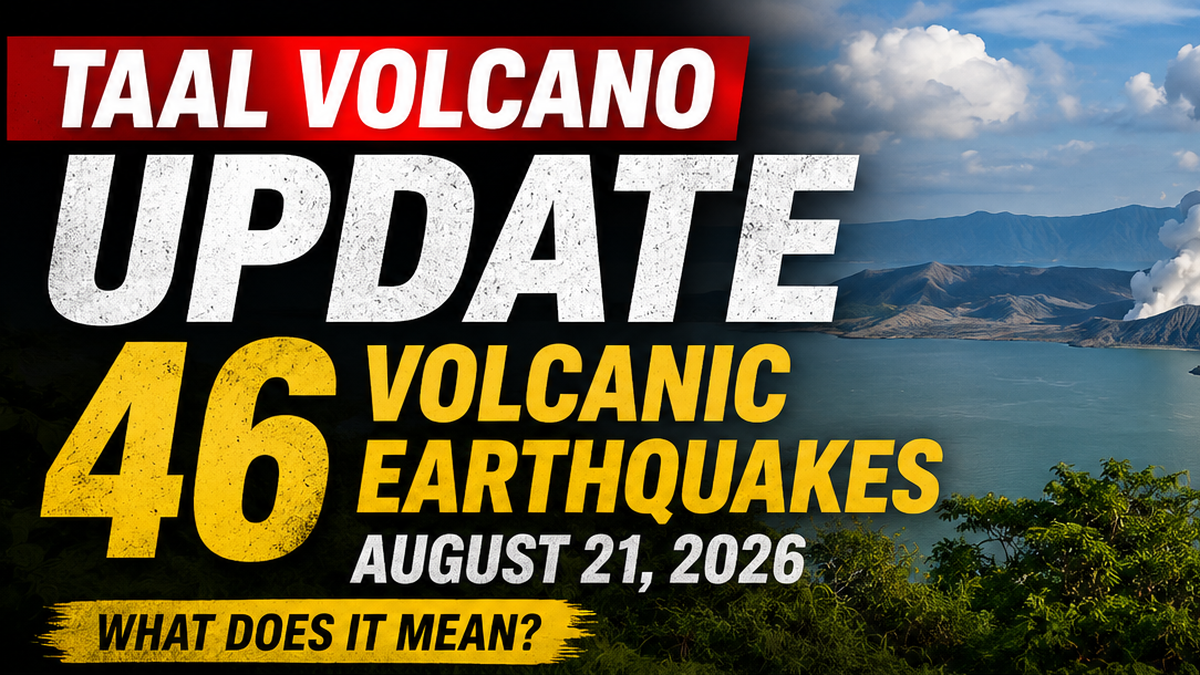
Taal Volcano recorded a noticeable increase in volcanic earthquakes on August 21, 2026, raising questions among residents and visitors in Batangas and nearby Tagaytay.
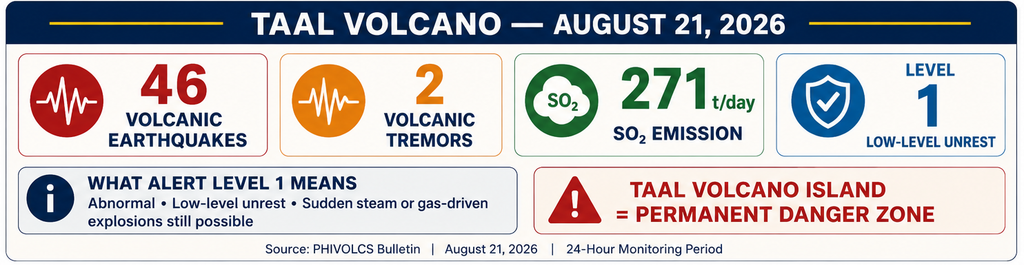
According to monitoring by the Philippine Institute of Volcanology and Seismology (PHIVOLCS), Taal recorded 46 volcanic earthquakes during the latest 24-hour monitoring period.
That is more than three times the 14 volcanic earthquakes recorded during the previous period.
However, this does not automatically mean that a major eruption is about to happen.
Taal Volcano remains under Alert Level 1, which means low-level volcanic unrest.
Here’s what the latest numbers mean and what people around Taal should know.
Taal Volcano Update at a Glance
| Monitoring Data | August 21, 2026 |
|---|---|
| Alert Level | 1 – Low-level unrest |
| Volcanic earthquakes | 46 |
| Previous monitoring period | 14 |
| Volcanic tremors | 2 |
| Tremor duration | 2 to 245 minutes |
| Vog observed | No |
| Hot-fluid upwelling observed | No |
| Taal Volcano Island | Permanent Danger Zone |
Why Did Taal Record 46 Volcanic Earthquakes?
Volcanic earthquakes are different from ordinary tectonic earthquakes.
They are caused by processes occurring inside or beneath an active volcano, which may involve:
- Movement of volcanic fluids
- Gas movement
- Changes in pressure
- Movement or fracturing of rock
- Magmatic or hydrothermal activity
The increase from 14 to 46 volcanic earthquakes therefore means that activity beneath Taal increased during this monitoring period.
PHIVOLCS also detected two volcanic tremor episodes, lasting from approximately two minutes to as long as 245 minutes.
Volcanic tremor is a more continuous seismic signal than an individual earthquake and can be related to the movement of gas or fluids within a volcanic system.
Does This Mean Taal Volcano Is About to Erupt?
Not necessarily.
A rise in volcanic earthquakes is something scientists monitor closely, but the earthquake count alone cannot tell us exactly when or whether an eruption will occur.
The most important point in today’s update is that PHIVOLCS has kept Taal Volcano at Alert Level 1.
Alert Level 1 means the volcano is in an abnormal condition with low-level unrest, but it does not mean a major eruption is considered imminent.
At the same time, Alert Level 1 should not be interpreted as meaning that Taal is completely inactive or risk-free.
Taal is an active volcano, and sudden volcanic activity can still occur.
What Other Signs Are PHIVOLCS Monitoring?
Earthquake numbers are only one part of volcano monitoring.
Scientists also watch several other indicators.
Sulfur Dioxide
Taal emitted approximately 271 metric tons of sulfur dioxide during the latest reported measurement.
PHIVOLCS classified the emission level as weak.
Sulfur dioxide, or SO₂, is one indicator scientists use to understand gas movement beneath an active volcano.
Main Crater Lake
No upwelling of hot volcanic fluids was observed in the Main Crater Lake during the latest monitoring period.
Volcanic Smog
No volcanic smog, commonly known as vog, was observed during the latest monitoring period.
These indicators are considered together with seismic activity, ground deformation and other monitoring data when PHIVOLCS evaluates the volcano.
Is Tagaytay Safe to Visit Right Now?
The August 21 bulletin does not announce an evacuation or closure of Tagaytay.
Taal Volcano also remains at Alert Level 1 rather than a higher alert level.
However, this should not be interpreted as a guarantee that conditions cannot change.
People planning to visit Tagaytay or communities around Taal Lake should check the latest:
- PHIVOLCS Taal Volcano bulletin
- Local government advisories
- Weather conditions
- Road and travel advisories
before traveling.
Visitors should also understand an important distinction:
Tagaytay City and Taal Volcano Island are not the same risk area.
The restrictions issued by PHIVOLCS specifically include Taal Volcano Island, which is designated as a Permanent Danger Zone (PDZ).
Can You Visit Taal Volcano Island?
No.
PHIVOLCS continues to advise against entry into Taal Volcano Island, particularly the:
- Main Crater
- Daang Kastila fissures
The island is considered a Permanent Danger Zone because dangerous volcanic events can occur with little or no warning.
Flying aircraft close to the volcano is also discouraged.
Possible hazards at Taal even during Alert Level 1 include:
- Sudden steam-driven or phreatic explosions
- Gas-driven explosions
- Volcanic earthquakes
- Minor ashfall
- Dangerous concentrations or releases of volcanic gas
Tourists should not assume that a low alert level makes visiting the volcano island safe.
Should Residents Around Taal Be Worried?
The increase to 46 volcanic earthquakes is worth monitoring, but it is not a reason to panic.
The best approach is to pay attention to changes in the official PHIVOLCS alert level and bulletins rather than individual social media posts about earthquake numbers.
For example:
46 earthquakes + Alert Level 1
does not have the same meaning as:
46 earthquakes + PHIVOLCS raising the volcano to Alert Level 2 or higher.
Changes in alert level are important because PHIVOLCS evaluates multiple monitoring parameters before changing the official status.
Why Taal Can Change Quickly
Taal is one of the Philippines’ most closely monitored active volcanoes.
Its volcanic system can produce relatively sudden steam-driven or phreatomagmatic activity.
In fact, Taal has experienced minor eruptive events even during periods when the broader volcanic unrest remained relatively low.
This is one reason why the Permanent Danger Zone around Taal Volcano Island remains restricted even at Alert Level 1.
What Should You Do?
For people living in Batangas, Cavite and nearby areas:
1. Follow PHIVOLCS
Use PHIVOLCS as the primary source for volcanic activity information.
2. Don’t rely on earthquake numbers alone
A headline saying that dozens of earthquakes occurred can sound alarming, but volcano monitoring involves many different indicators.
3. Avoid Taal Volcano Island
The Permanent Danger Zone remains restricted regardless of whether the volcano looks quiet.
4. Watch for official alert-level changes
An increase in the official PHIVOLCS alert level would be more significant than a change in one monitoring parameter alone.
5. Be careful with viral posts
Photos, videos and claims about Taal frequently circulate on Facebook and other social media platforms.
Check whether they are recent and whether PHIVOLCS has confirmed the information before sharing them.
Frequently Asked Questions
What is Taal Volcano’s alert level today?
As of August 21, 2026, Taal Volcano remains at Alert Level 1 — low-level unrest.
How many volcanic earthquakes were recorded?
PHIVOLCS recorded 46 volcanic earthquakes during the latest 24-hour monitoring period.
Is Taal Volcano erupting?
No major eruption was reported in the latest August 21 monitoring update.
The volcano remains under Alert Level 1.
Does 46 earthquakes mean Taal will erupt?
No.
An increase in volcanic earthquakes indicates increased seismic activity, but it does not by itself predict an imminent eruption.
PHIVOLCS evaluates seismic activity together with gas emissions, ground deformation and other indicators.
Is Tagaytay being evacuated?
No evacuation of Tagaytay was announced in connection with the August 21 update.
Travelers should nevertheless monitor PHIVOLCS and local government advisories because volcanic conditions can change.
Can tourists go to Taal Volcano Island?
No.
Taal Volcano Island remains a Permanent Danger Zone, and entry is prohibited.
Final Update
Taal Volcano recorded 46 volcanic earthquakes and two volcanic tremor episodes in the latest monitoring period reported on August 21, 2026.
The increase is notable and will continue to be monitored.
But for now, Taal remains at Alert Level 1, and PHIVOLCS has not announced an escalation of the volcano’s alert status.
The key message is simple:
Stay informed, but don’t panic because of the earthquake count alone.
Residents and visitors should follow official PHIVOLCS bulletins for the latest information, avoid Taal Volcano Island, and be cautious about unverified information circulating on social media.