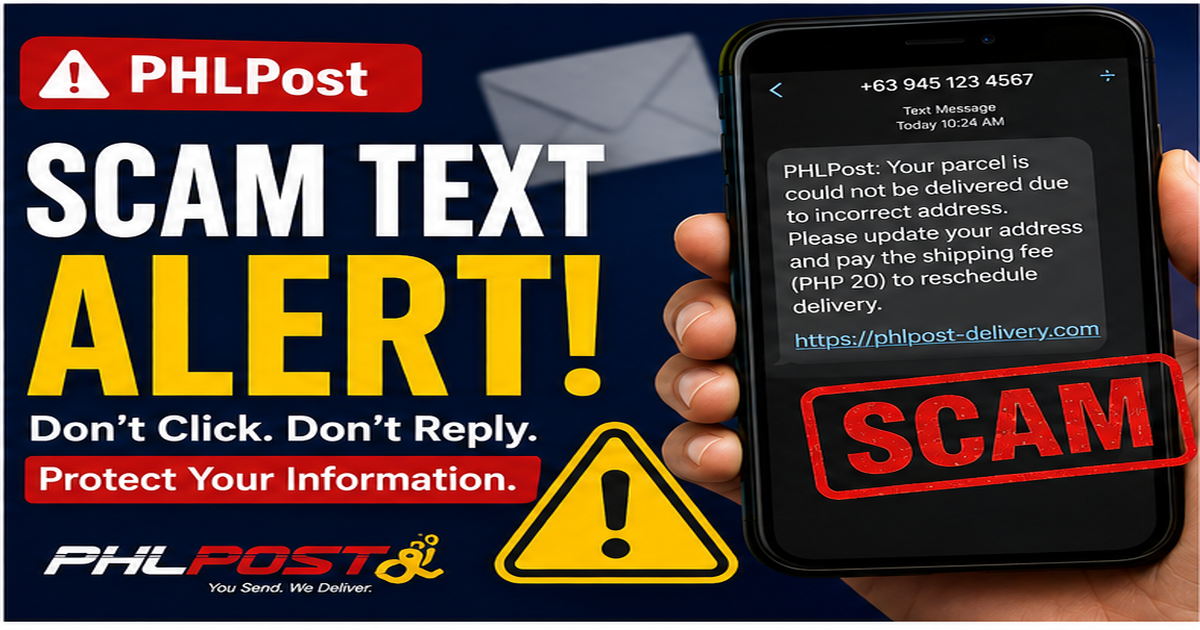
Have you received a text saying that your PHLPost package cannot be delivered because your address is incomplete?
Do not click the link immediately.
Fake PHLPost delivery messages are circulating in the Philippines, and fresh reports of suspicious PHLPost-branded messages have appeared online again in August 2026.
One user reported receiving a suspicious PHLPost message on August 23 even though they were not expecting any PHLPost delivery. The tracking number provided in the message did not work on the official PHLPost tracking system, and the website address was unrelated to the real PHLPost domain. Similar reports were also shared by other Philippine users in the days before.
This is not a new scam.
PHLPost has previously issued official warnings about criminals using its name and logo to trick people into clicking fraudulent delivery links and providing personal or financial information.
Real PHLPost Scam Texts Reported in the Philippines
These are not hypothetical examples.
Similar messages have actually been reported in the Philippines.
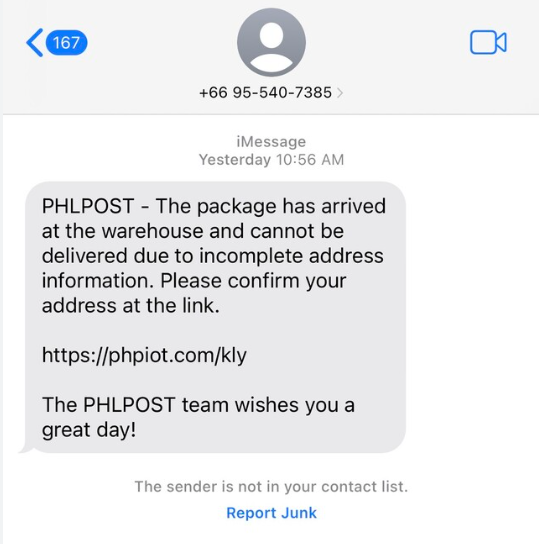
One documented scam message said:
“Your package has arrived at the warehouse but cannot be delivered due to incomplete address details.”
The message then directed the recipient to a fraudulent website and even instructed them to reply to the SMS before opening the link.
HSBC Philippines included this exact PHLPost impersonation attempt as an example in its security warning about SMS spoofing.
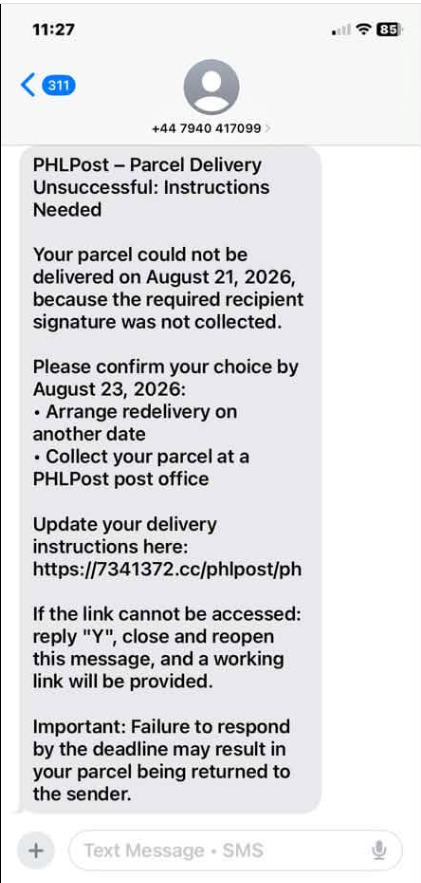
Another reported message claimed that a package had arrived at a local postal facility but could not be delivered because the address was wrong.
Recipients were then instructed to update their address and reply to the message to receive a package link.
PHLPost publicly identified messages following this pattern as phishing attempts.
For safety, phishing URLs should not be opened or copied into your browser.
If you are sharing a screenshot of a scam message with other people, it is also a good idea to blur or remove the malicious URL.
The ₱17.05 PHLPost Scam
One particularly important version of the scam has been officially confirmed by PHLPost.
In a May 13, 2025 advisory, PHLPost warned about fraudulent messages claiming:
- A parcel could not be delivered because of an incorrect address
- The recipient needed to update the address
- A payment of ₱17.05 was required
- A link was provided to supposedly complete the transaction
PHLPost stated that the website included in these messages was fake and was not owned by the postal agency.
The unusually small amount is important.
₱17.05 may not seem like enough money to justify a scam.
But the real target may not be the ₱17.
The fake payment page may instead be designed to collect your:
- Credit or debit card number
- Card expiration date
- CVV
- Full name
- Address
- Phone number
- Online banking information
- OTP
Once criminals obtain this information, the potential loss can be much greater than the small amount shown in the original message.
Why These Delivery Scams Work
Delivery scams are especially convincing in the Philippines because so many people are constantly waiting for packages.
You may have an order arriving from:
- Shopee
- Lazada
- TikTok Shop
- Amazon
- An overseas seller
- A relative abroad
- Another courier service
Then a message suddenly appears saying:
“Your package could not be delivered.”
The timing can feel too perfect to be a coincidence.
But scammers can send the same message to thousands of phone numbers.
Some of those recipients will naturally be waiting for a delivery at that exact moment.
In fact, one recent Philippine user reported receiving a similar courier scam while genuinely expecting packages that day.
That is why you should verify the message independently instead of trusting it simply because you happen to have a package on the way.
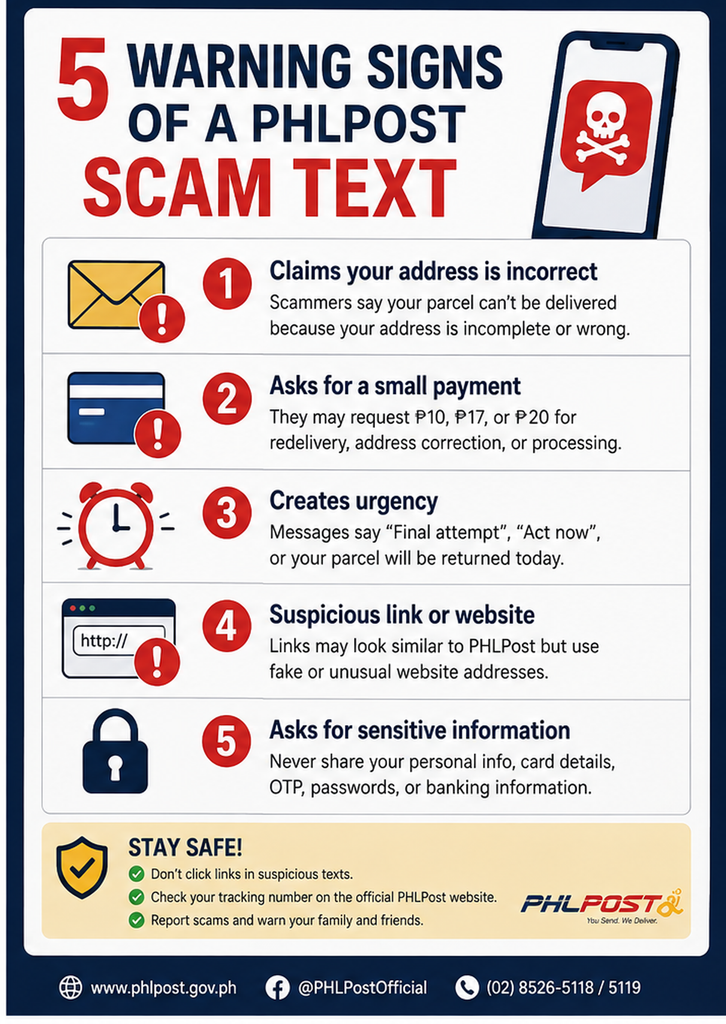
5 Warning Signs of a Fake PHLPost Text
1. It Says Your Address Is Wrong
A common message says your parcel cannot be delivered because your address is incomplete or incorrect.
You are then asked to “update” your address through a link.
This exact tactic has repeatedly appeared in documented PHLPost phishing scams.
2. It Asks for a Small Payment
Be suspicious if the message asks you to pay a small fee for:
- Address correction
- Redelivery
- Processing
- Storage
- Delivery confirmation
PHLPost’s official advisory specifically documented the ₱17.05 version of this scam.
3. It Creates Urgency
Scammers often use phrases such as:
- “Final delivery attempt”
- “Update within 24 hours”
- “Your parcel will be returned”
- “Immediate action required”
PHLPost has previously warned about fraudulent messages claiming that parcels would be returned unless recipients quickly confirmed their address and banking details.
4. The Link Does Not Belong to PHLPost
This is one of the easiest warning signs.
The official PHLPost website is:
phlpost.gov.ph
A phishing site may contain words such as:
phlpost-delivery
phlpost-update
phlpost-track
or another combination intended to look official.
A website can copy the PHLPost logo, colors, and design.
That does not make it legitimate.
Recent victims have also reported receiving links with addresses completely unrelated to the official PHLPost domain.
5. It Asks for Sensitive Information
Be extremely cautious if a delivery page asks for:
- Credit or debit card details
- CVV
- Banking password
- OTP
- Passport information
- Other sensitive personal data
PHLPost warns that fraudulent links may be used to obtain personal and financial information.
How to Check a Real PHLPost Package
Do not check your parcel by using the link contained in a suspicious SMS.
Instead:
- Open your browser yourself.
- Go directly to the official PHLPost website.
- Use the official tracking system.
- Enter your actual tracking number.
- Contact PHLPost directly if something appears wrong.
PHLPost advises customers expecting parcels to verify them through its official channels.
Official PHLPost Contact Information
Website:
phlpost.gov.ph
Customer Service:
(02) 8288-POST
(02) 8288-7678
Email:
phlpostcares@phlpost.gov.ph
PHLPost currently lists these contact details on its official website.
What Should You Do If You Receive a Scam Text?
If you receive a suspicious PHLPost message:
Do not click the link.
Do not reply.
Do not call a telephone number contained in the suspicious message.
Do not provide personal information.
Do not enter card details.
Instead, take a screenshot if you want to report the message, block the sender, and verify your parcel using PHLPost’s official channels.
PHLPost specifically advises the public not to respond to fraudulent messages, click the links, or call numbers provided by scammers.
What If You Already Clicked the Link?
If you clicked the link but did not enter any information, close the webpage.
Do not download anything from the site.
Do not install any application it recommends.
Make sure your browser and phone operating system are updated.
Simply opening a page does not necessarily mean your bank account has been compromised, but you should not continue interacting with the site.
What If You Entered Personal Information?
If you entered information such as your:
- Email address
- Phone number
- Password
- Address
- Account information
change important passwords and closely monitor your accounts.
Be particularly cautious about follow-up calls or messages.
A scammer who already knows your name, phone number, address, or other information can create a much more convincing second scam.
What If You Entered Your Card Information?
Contact your bank or card issuer immediately.
Tell them that your card information may have been entered into a phishing website.
The bank may recommend:
- Locking the card
- Cancelling the card
- Replacing the card
- Monitoring recent transactions
- Disputing unauthorized charges
Do not wait until you see a large unauthorized transaction.
Never Share an OTP
If someone contacts you after you have entered your card information and asks for an OTP, do not give it to them.
The OTP may be the final step needed to authorize a fraudulent transaction.
HSBC’s warning about SMS spoofing specifically notes that fraudulent websites may attempt to obtain both card information and OTPs.
Foreigners Living in the Philippines Should Be Careful Too
Expats, foreign residents, international students, and tourists can also receive these messages.
They may actually be more difficult to identify if you are unfamiliar with how Philippine government agencies or local courier companies normally communicate.
If you receive a message claiming to come from:
- PHLPost
- LBC
- J&T Express
- Ninja Van
- Flash Express
- DHL
- Another courier
use the same rule:
Never verify the delivery through the link contained in the suspicious message.
Open the courier’s official website or application yourself.
A Real Delivery Does Not Make the Text Real
This is perhaps the most important thing to remember.
You might actually be waiting for a package.
That does not prove that the SMS is genuine.
Check your original Shopee, Lazada, TikTok Shop, Amazon, seller, or courier tracking information instead.
Then compare the tracking information with the official courier website.
Fake vs. Real: The 10-Second Check
When a delivery message arrives, ask yourself:
Is it asking me to click a link?
Is it asking me to correct my address?
Is it asking for money?
Is it asking for card or personal information?
Is the website really phlpost.gov.ph?
If anything looks suspicious, stop.
Open PHLPost’s official website yourself and verify the parcel independently.
The Bottom Line
PHLPost delivery-text phishing scams are real, and reports of suspicious messages are still appearing in the Philippines in August 2026.
The scam may claim that your address is incomplete, your parcel cannot be delivered, or that you need to pay a very small amount such as ₱17.05.
PHLPost has officially warned the public about this specific type of scam.
Remember:
STOP → DON’T CLICK → CHECK THE TRACKING NUMBER → VISIT THE OFFICIAL WEBSITE YOURSELF
A few seconds of verification can protect your personal information, card details, and bank account.
This article is for public awareness and informational purposes. Scam methods and fraudulent website addresses can change quickly. Always verify suspicious delivery messages through the official courier website or customer service channels.