The Philippine peso has entered another difficult period.
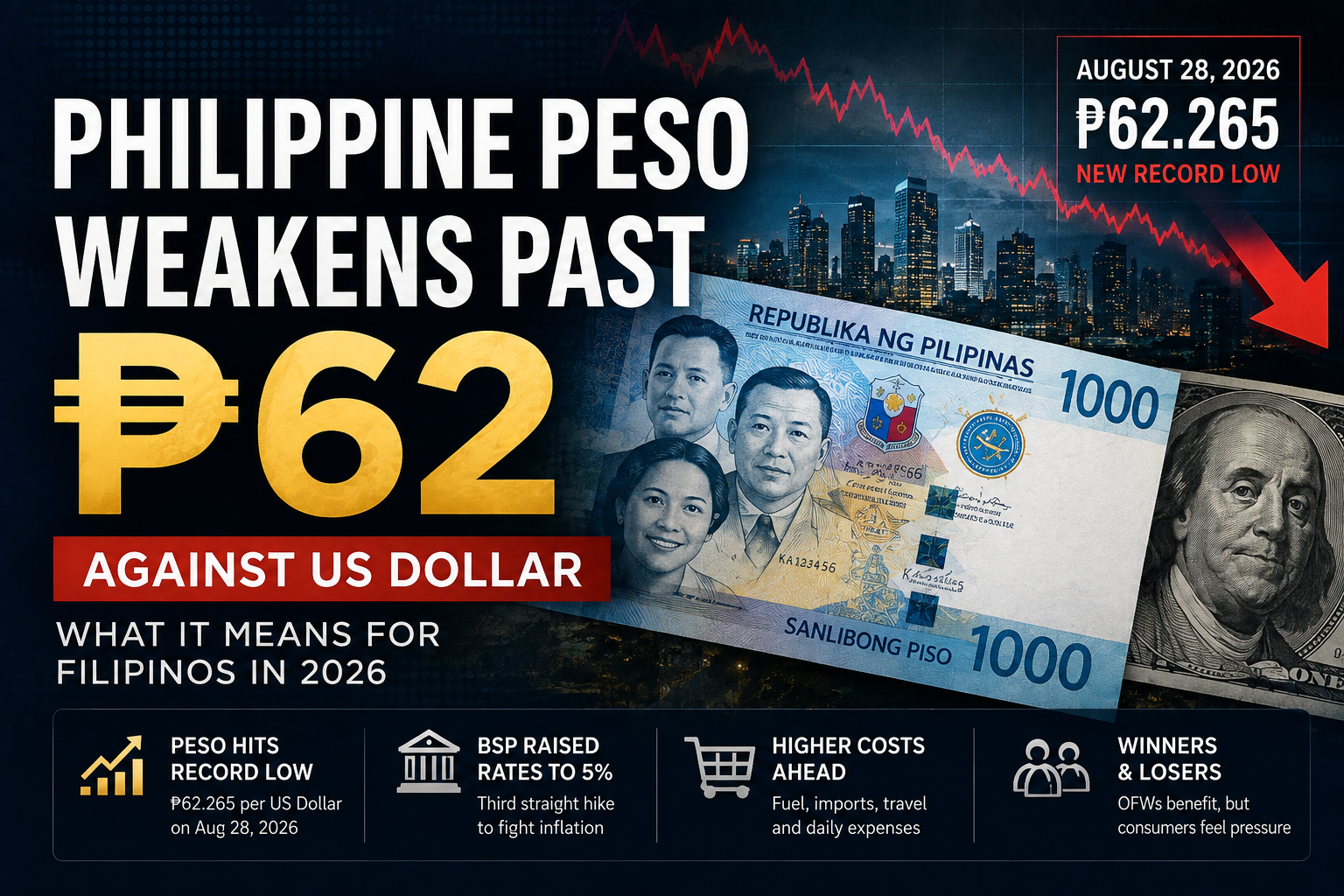
On August 28, 2026, the peso weakened past the ₱62 level against the US dollar, putting the currency near historically weak territory and once again raising concerns about inflation, fuel prices, imported goods, and the cost of living in the Philippines.
For many Filipinos, however, exchange rates can feel like something that only matters to banks, investors, or people traveling abroad.
That is not the case.
A weaker peso can eventually affect everything from gasoline and groceries to gadgets, overseas travel, OFW remittances, and even loan interest rates.
So why is the Philippine peso weakening — and what does a ₱62 exchange rate actually mean for ordinary Filipinos?
How Weak Is the Philippine Peso Right Now?
The peso moved beyond ₱62 against the US dollar on August 28, 2026, continuing the currency’s significant weakness during the year.
In simple terms:
US$1 now buys more than ₱62.
That can be good news if you receive or earn US dollars.
But if you need to buy something priced in dollars, the opposite happens: you need more pesos to pay for the same item.
For example:
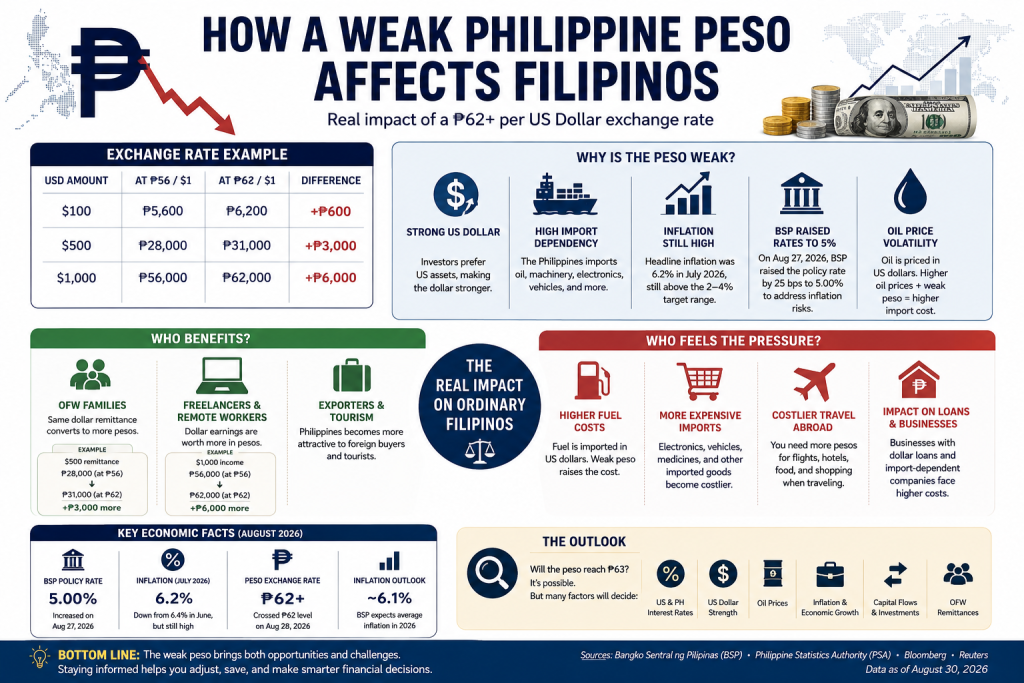
| Amount | At ₱56/$1 | At ₱62/$1 |
| $100 | ₱5,600 | ₱6,200 |
| $500 | ₱28,000 | ₱31,000 |
| $1,000 | ₱56,000 | ₱62,000 |
A movement from ₱56 to ₱62 therefore represents a meaningful difference for households and businesses dealing with foreign currencies.
Why Is the Philippine Peso Weakening?
There isn’t one single reason.
Currency movements are influenced by both international markets and conditions inside the Philippine economy.
1. A Strong US Dollar
One of the biggest factors affecting the peso is the strength of the US dollar.
When investors prefer dollar-denominated assets, demand for dollars increases. This can put pressure on currencies such as the Philippine peso.
And the Philippines is particularly sensitive to dollar movements because many important commodities — including oil — are traded internationally in US dollars.
2. The Philippines Imports a Lot of What It Uses
The Philippines depends heavily on imports for products such as:
- crude oil and petroleum products
- machinery
- electronics and components
- vehicles
- industrial materials
- some food products
Philippine importers therefore regularly need US dollars.
When demand for dollars increases, it can add pressure on the peso.
This also creates another problem.
If the peso becomes weaker, imported products become more expensive in peso terms.
3. Inflation Is Still High
The Philippines is also dealing with elevated inflation.
According to the Philippine Statistics Authority, headline inflation was 6.2% in July 2026, slightly lower than 6.4% in June but still significantly above the Bangko Sentral ng Pilipinas’ target range.
Food inflation was 5.3%, while transport prices remained one of the important contributors to overall inflation.
This matters because currency weakness can make inflation more difficult to control.
If imported fuel, raw materials, machinery, and food become more expensive because of the exchange rate, businesses may eventually pass some of those costs on to consumers.
BSP Raised Interest Rates to 5%
The Bangko Sentral ng Pilipinas is already responding to inflation risks.
On August 27, 2026, the BSP increased its key policy rate by 25 basis points:
4.75% → 5.00%
This was the central bank’s third consecutive rate increase.
The BSP said the move was intended to address inflation risks, including volatile oil prices, possible wage adjustments, and the potential effects of El Niño on food prices.
The BSP now expects average inflation of around 6.1% in 2026.
Interest rate increases can help control inflation and support the peso, but they also have consequences.
Higher interest rates can eventually make borrowing more expensive for households and businesses.
What Does a Weak Peso Mean for Ordinary Filipinos?
This is where exchange rates become much more than financial news.
⛽ Fuel Could Become More Expensive
The Philippines imports most of its crude oil and petroleum requirements.
Oil is generally traded internationally in US dollars.
That means even if the international price of oil does not change, a weaker peso can increase the peso cost of importing fuel.
Higher fuel costs can then affect:
- transportation
- delivery services
- electricity
- agricultural production
- manufacturing
- food distribution
This is one reason exchange rates can eventually affect prices across the economy.
🛒 Imported Products Become More Expensive
Products imported from overseas may also become more expensive.
This can include:
- smartphones
- laptops
- computer components
- appliances
- vehicles
- imported food
- medicines and medical equipment
- business equipment
Businesses importing raw materials can also face higher costs.
Some of those costs may eventually be passed on to consumers.
✈️ Overseas Travel Becomes More Expensive
Planning a trip abroad?
A weak peso isn’t particularly helpful.
Suppose your hotel, food, transportation and shopping budget is $1,000.
At ₱56 per dollar:
$1,000 = ₱56,000
At ₱62 per dollar:
$1,000 = ₱62,000
That’s an additional ₱6,000 without buying anything extra.
Filipinos traveling to countries where expenses are effectively tied to the US dollar may therefore notice a significant difference.
But There Are Winners Too
A weak currency isn’t bad for everyone.
Some Filipinos actually benefit from it.
💵 OFW Families Receive More Pesos
This is perhaps the most obvious example.
Suppose an OFW sends:
$500 per month
At ₱56/$1:
$500 × ₱56 = ₱28,000
At ₱62/$1:
$500 × ₱62 = ₱31,000
That’s approximately ₱3,000 more from the same $500 remittance before fees and exchange-rate spreads.
This is why a weaker peso can temporarily increase the peso purchasing power of families receiving foreign currency.
However, there is an important catch.
If peso weakness contributes to higher fuel, food, transportation and electricity prices, some of that advantage can eventually disappear.
In other words:
More pesos from remittances do not necessarily mean greater purchasing power over the long term.
💻 Freelancers and Remote Workers Can Also Benefit
Filipinos working remotely for foreign companies may experience a similar effect.
If you earn:
$1,000 per month
At ₱56/$1, that’s around:
₱56,000
At ₱62/$1:
₱62,000
The difference is approximately ₱6,000.
Dollar-earning freelancers, BPO companies, exporters, and other businesses receiving foreign currencies can therefore benefit from peso depreciation.
Is ₱63 per Dollar Possible?
It is possible, but nobody can reliably predict the exact exchange rate.
The peso’s direction will depend on several factors, including:
- US interest rates
- strength of the US dollar
- global oil prices
- Philippine inflation
- BSP monetary policy
- imports and exports
- foreign investment flows
- OFW remittances
- geopolitical developments
The ₱62 level is psychologically important, but currencies do not automatically stop moving simply because they reach a round number.
That means ₱63 cannot be ruled out.
At the same time, a reversal in global dollar strength, lower oil prices, improved inflation expectations, or stronger foreign capital inflows could allow the peso to recover.
Should You Buy US Dollars Now?
That depends on why you need them.
Trying to predict short-term currency movements is extremely difficult.
If you know you will need dollars for tuition, travel, business payments, or another future expense, buying the entire amount at one exchange rate carries timing risk.
One practical strategy is to convert money gradually instead of trying to find the perfect exchange rate.
For example, someone who needs $3,000 several months from now could purchase smaller amounts periodically.
This reduces the risk of converting everything on the worst possible day.
However, currency decisions should always depend on your personal financial situation and purpose.
Is a Weak Peso Good or Bad for the Philippines?
The answer is:
Both.
Potential winners
✔ OFWs and their families
✔ Dollar-earning freelancers
✔ BPO companies
✔ Exporters
✔ Foreign tourists visiting the Philippines
✔ People holding US-dollar assets
Potential losers
✘ Consumers buying imported products
✘ Businesses dependent on imported materials
✘ Overseas travelers
✘ Companies with US-dollar debt
✘ Households affected by higher fuel and transportation costs
The biggest concern is inflation.
A weaker peso itself isn’t necessarily an economic crisis.
But if currency depreciation combines with high oil prices and already-elevated inflation, the impact can spread throughout the economy.
The Bottom Line
The Philippine peso moving beyond ₱62 per US dollar is more than just a number on a foreign-exchange board.
For OFWs and dollar earners, it can mean more pesos for every dollar earned.
For consumers, businesses and travelers, however, it can mean higher costs.
The more important question isn’t simply:
“Will the peso reach ₱63?”
It is:
“How long will the peso remain weak, and how much of that weakness will eventually appear in Philippine consumer prices?”
With inflation still elevated and the BSP raising its policy rate to 5%, the peso-dollar exchange rate will remain one of the most important economic indicators to watch in the Philippines during the remainder of 2026.
This article is for general informational purposes only and should not be considered financial or investment advice.
Frequently Asked Questions
What is the Philippine peso exchange rate in August 2026?
The Philippine peso weakened beyond ₱62 against the US dollar on August 28, 2026. Actual exchange rates offered by banks, money changers, remittance companies, and credit cards may differ from market rates.
Why is the Philippine peso weak?
Several factors can affect the peso, including US dollar strength, Philippine inflation, oil prices, demand for imports, interest-rate expectations, foreign investment flows and geopolitical uncertainty.
Is a weak peso good for OFWs?
It can be beneficial in the short term because each US dollar sent to the Philippines converts into more pesos. However, higher inflation caused partly by more expensive imports can reduce that benefit over time.
Does a weak peso increase gasoline prices?
It can. Because petroleum is traded internationally in US dollars and the Philippines relies heavily on imported fuel, a weaker peso increases the local-currency cost of purchasing dollar-priced oil.
Will the Philippine peso reach ₱63 per dollar?
It is possible, but exchange rates are extremely difficult to predict. Future movements will depend on global dollar strength, US and Philippine interest rates, inflation, oil prices, investment flows and other economic conditions.
Why did the BSP raise interest rates?
The BSP raised its key policy rate to 5.00% in August 2026 as a preemptive response to inflation risks. Higher interest rates can help reduce inflationary pressure, although they can also increase borrowing costs.