If your social media feed suddenly makes it look as if Makati has become an independent country, do not worry. You do not need a visa, there is no official “Makati dollar,” and “Makatinese” is not a newly recognized language.
The “United States of Makati” is a viral Filipino social media meme that turns everyday corporate life in Makati into a fictional overseas experience.
Office workers call themselves “OFWs,” talk about earning Makati dollars, apply for imaginary work visas, and describe their return-to-office days as if they were working in another country.
But the joke is not only about working onsite.
For some workers, especially those who moved away from their hometowns to find work in Makati, their daily lives can resemble those of real Overseas Filipino Workers. They leave their families, rent a place near their workplace, send much of their salary home, and return only during weekends, holidays, or longer breaks.
The main difference is that they never crossed an international border.
Quick Answer
“United States of Makati” is an unofficial and humorous nickname for Makati City.
The meme became popular among office workers who jokingly redefined OFW as “Onsite Filipino Worker” or “Overworked Filipino Worker.” It grew from return-to-office and day-in-the-life videos posted around July and August 2026 before spreading across TikTok, Facebook, Instagram, and other platforms.
The comparison also reflects a familiar Filipino experience. Many workers leave their provinces, live in dormitories or rented rooms near Makati, and send a large part of what they earn back to their families.
Although they are not technically overseas, their separation from home, financial responsibilities, and occasional homecomings can feel surprisingly similar to the life of an OFW.
What Do the Makati Meme Terms Mean?
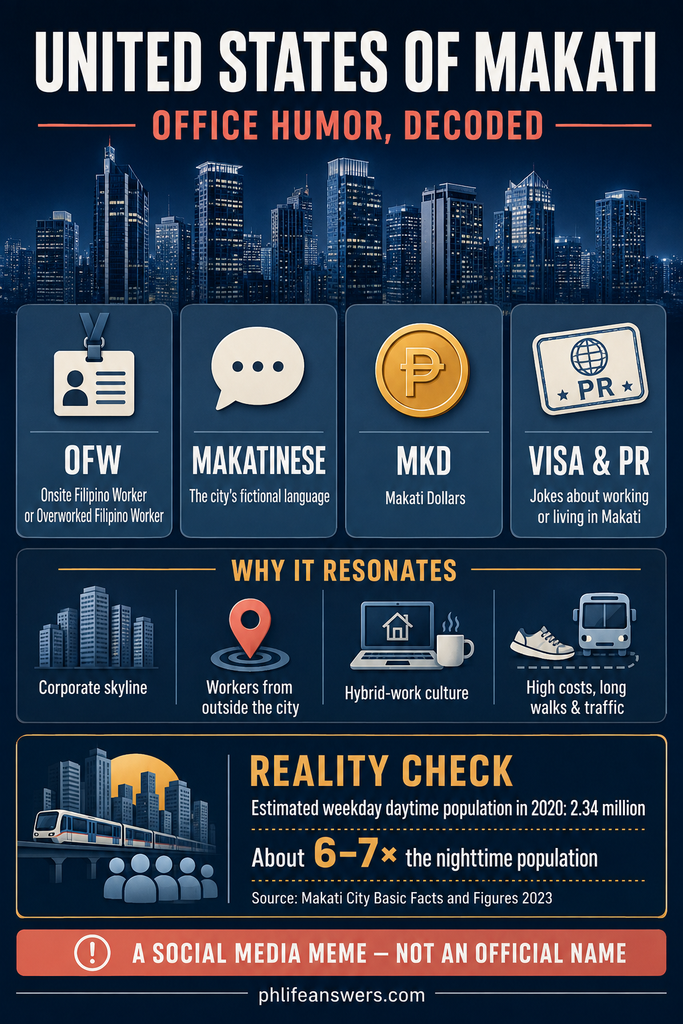
| Meme term | Meaning |
|---|---|
| United States of Makati | Makati imagined as a separate country |
| OFW | “Onsite Filipino Worker” or “Overworked Filipino Worker” |
| Makatinese | The fictional language spoken in Makati |
| MKD or Makati Dollars | The city’s imaginary currency |
| Visa | A joke about being accepted for a Makati-based job |
| PR | “Permanent residency” after working or living in Makati |
| Holiday mode | Spending a day off exploring Makati like a tourist |
| Remittance | Sending part of a Makati salary back to one’s hometown |
The jokes imitate the language commonly associated with overseas Filipino workers. Instead of leaving the Philippines, however, these workers are supposedly “leaving the country” to report to an office in Makati.
How Did the United States of Makati Meme Start?
There is no single verified creator of the entire trend.
It appears to have developed through several return-to-office and day-in-the-life videos posted between July and August 2026.
One of the earliest widely reported examples came from TikTok creator @nickxploration, who posted a typical Makati workday with the line:
“Umalis ng Pilipinas para mag-work sa Makati.”
The video treated a regular office day like an overseas assignment. Other creators soon added their own stories about getting a Makati work visa, learning Makatinese, earning MKD, finding affordable food during petsa de peligro, and returning to the Philippines during their days off.
Social media users then expanded the story. Workers joked about converting Makati dollars into Philippine pesos, sending MKD remittances to their families, applying for permanent residency, and traveling back to their hometowns like returning overseas workers.
The OFW Comparison Is More Than a Wordplay
Calling Makati employees “OFWs” is not simply a joke about reporting to the office.
For many Filipinos, accepting a job in Makati means leaving a hometown in another province or a distant part of Metro Manila. Daily commuting may be too expensive, exhausting, or time-consuming, so workers sometimes rent a dormitory, bedspace, apartment, or shared condominium closer to their workplace.
Their families may remain in Bulacan, Cavite, Laguna, Rizal, Batangas, Quezon, Bicol, or even farther away.
After receiving their salary, some workers send a large portion—and sometimes nearly everything left after basic expenses—back home to support parents, spouses, children, or other relatives.
They may only return to their hometown during weekends, holidays, or longer breaks.
That routine has several similarities to the life of an Overseas Filipino Worker:
- Leaving home to find better employment
- Living away from family
- Adjusting to a more expensive place
- Sharing accommodation with other workers
- Sending money back home
- Looking forward to the next homecoming
- Making financial sacrifices for relatives who stayed behind
The obvious difference is that a Makati worker has not left the Philippines.
This is why “OFW in Makati” feels more meaningful than a simple acronym joke. Behind the humor is a familiar Filipino story of economic migration, family responsibility, and workers going wherever better employment opportunities can be found.
Even jokes about sending “Makati dollars” home resemble the remittance culture commonly associated with Filipinos working abroad.
How the Meme Became Mainstream
The joke moved beyond individual office workers when major businesses and tourism pages joined the trend.
Tourism Philippines presented Makati as a “visa-free” urban destination and encouraged followers to bring their Makati dollars and start learning Makatinese.
Its promotional cards featured gallery hopping, weekend markets, cafés, restaurants, running, staycations, city lights, and nightlife. One card also encouraged visitors to become “OFWs,” meaning Onsite Filipino Workers.
One Ayala posted a weather update from the fictional United States of Makati, while Make It Makati encouraged visitors to experience the city.
At that point, the meme had evolved from office humor into an unofficial city marketing campaign.
Why Does Makati Feel Like Another Country?
Makati looks different from many other Philippine cities
Glass towers, international companies, luxury malls, landscaped walkways, corporate offices, upscale villages, and busy business districts give parts of Makati a noticeably different atmosphere.
For workers arriving from the provinces or other parts of Metro Manila, entering the Makati Central Business District can feel like stepping into another country—especially after a long commute through congested roads and crowded public transportation.
The polished corporate environment also contrasts sharply with the places where many workers actually live.
The daytime population transforms the city
The Philippine Statistics Authority lists Makati’s 2024 population at 309,770 across 23 barangays.
Separately, Makati City’s official 2023 facts sheet—using a 2020 estimate—placed the city’s weekday daytime population at approximately 2.34 million, around six to seven times its nighttime population.
These figures use different reference years, but they illustrate the basic reality behind the meme: huge numbers of people enter Makati to work, study, shop, conduct business, and access services before leaving again at the end of the day.
Many of the people who keep Makati running are therefore not permanent residents. Some commute every day, while others temporarily live near the city because their hometowns are too far away.
In that sense, many Makati “OFWs” really are temporary economic residents.
Hybrid work makes office days feel like business trips
Hybrid work has added another layer to the joke.
Employees who work from home most of the week may visit Makati only once or twice. They prepare office clothes, pack laptops and chargers, check transportation conditions, budget for meals, and leave home much earlier than usual.
The trip can begin to feel less like an ordinary commute and more like traveling to another country for a short work assignment.
The humor hides real frustrations
The meme is funny, but many of its best jokes are based on familiar difficulties:
- Long and exhausting commutes
- Expensive meals, coffee, rent, and parking
- Long walks between offices and transportation stops
- Traffic that can turn a short distance into a long journey
- The pressure and exhaustion associated with corporate work
- Workers relocating far from their families
- Sending most of their remaining salary back home
- Waiting for the next payday or petsa de peligro
- Returning home only during weekends or holidays
The fictional visas, currencies, remittances, and immigration stories allow workers to talk about these experiences without turning every post into a serious complaint.
Is the Meme Praising Makati or Making Fun of It?
It does both.
The “United States of Makati” trend romanticizes the city’s skyline, walkable business areas, cafés, weekend markets, and corporate lifestyle.
At the same time, it makes fun of high living costs, office pressure, difficult commutes, expensive housing, and the social distance between Makati’s polished business districts and the communities where many workers and their families live.
Online reactions have been mixed.
Many users enjoy the creativity and share their own Makati immigration stories. Others find the trend corny or believe it romanticizes an exhausting corporate routine.
Both interpretations can be true. Makati can represent opportunity and career growth while also requiring workers to make significant financial and personal sacrifices.
The Joke Is No Longer Limited to Makati
Filipinos soon began creating imaginary countries and territories for other locations.
Examples shared online included the “United Kingdom Capital of BGC,” the “United States of Alabang,” “Ilocoslovakia,” “Cavitestan,” “Cebudapest,” and the “United Bulacan Emirates.”
Commuters also transformed expressways, floods, traffic, hometowns, and work-from-home arrangements into parts of their fictional international journeys.
One worker might describe traveling from “Dasmariñas, Texas” to the United States of Makati, while another might say they have left Makati and returned home to “Cavitzerland.”
The original Makati joke has now become a wider form of Filipino place-name humor.
Final Takeaway
The United States of Makati is not a real country, but the experiences behind the joke are very real.
It reflects Makati’s unusual identity as a city where permanent residents are joined by a much larger weekday population of employees, commuters, customers, students, and visitors.
More importantly, it reflects the experiences of workers who leave their hometowns, live away from their families, and send part of their earnings back home.
For some, Makati represents career opportunities and an exciting urban lifestyle. For others, it means expensive meals, shared accommodation, crowded transportation, long walks, and demanding office days.
The meme works because it turns all of those experiences into one shared Filipino joke—complete with OFWs, Makati dollars, work visas, remittances, permanent residents, and the fictional Makatinese language.
Behind the humor is a simple reality: you do not always have to leave the Philippines to feel like you are working far away from home.
This article explains a social media trend as of August 29, 2026. “United States of Makati,” “Makatinese,” “Makati dollars,” and the related immigration terms are humorous expressions, not official names or government classifications.
Frequently Asked Questions
Is the United States of Makati a real place?
No. It is an unofficial social media nickname for Makati City. Makati remains a city within Metro Manila in the Philippines.
What does OFW mean in the Makati meme?
It usually means “Onsite Filipino Worker” or “Overworked Filipino Worker.” It is a playful reinterpretation of Overseas Filipino Worker.
The joke can also refer to workers who left their hometowns, live near Makati for work, send money to their families, and return home only during weekends or holidays.
Why are Makati workers compared with Overseas Filipino Workers?
Some Makati employees live away from their families because their hometowns are too far from the city. They rent accommodation near work, manage higher living expenses, and send part of their salary home.
Although they remain in the Philippines, their lifestyle can resemble that of an overseas worker.
What is Makatinese?
Makatinese is the fictional language of the United States of Makati. It is not a real or officially recognized language.
What are Makati dollars or MKD?
Makati dollars are an imaginary currency used in the meme. Workers jokingly describe their salaries, expenses, and remittances in MKD, but all real transactions remain in Philippine pesos.
Who started the United States of Makati meme?
No single creator has been conclusively identified. The trend grew through several office-life videos posted around July and August 2026.
TikTok creator @nickxploration was responsible for one of the earliest examples highlighted by Philippine media.
Do visitors need a visa to enter Makati?
No. The visa and immigration references are part of the joke.
Filipinos and foreign visitors can enter Makati like any other city in Metro Manila, subject only to the normal Philippine immigration rules that apply to foreign nationals entering the country.