
Planning to take out a personal loan in the Philippines?
Before accepting a loan offer, it is important to understand more than just the advertised monthly interest rate.
A loan advertised at 1.5% per month does not necessarily mean that your actual annual borrowing cost is simply 18%.
Processing fees, other upfront charges, the repayment method and the way interest is calculated can make the real cost of borrowing significantly higher.
Use our Philippines Loan Calculator below to estimate your:
- Monthly loan payment
- Total interest
- Total repayment
- Processing and other upfront fees
- Net loan proceeds
- Total borrowing cost
- Estimated Effective Interest Rate (EIR)
Updated: September 2026
Philippines Personal Loan Calculator
Philippines Loan Calculator
Estimate your monthly payment, total interest, net proceeds and Effective Interest Rate (EIR).
How to Use the Philippines Loan Calculator
Using the calculator is simple.
Enter the information shown in your loan quotation or offer.
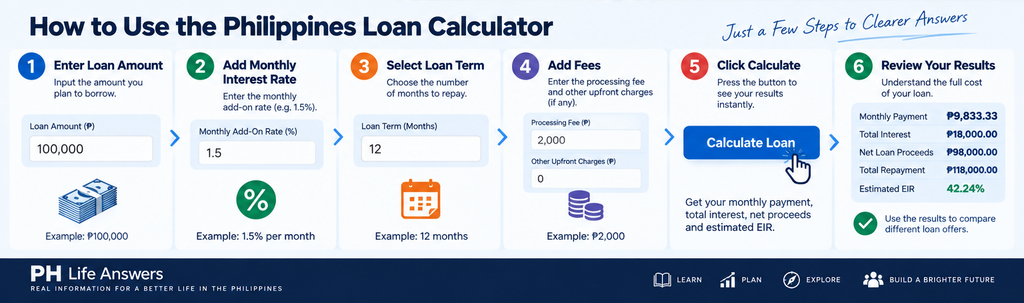
Loan Amount
Enter the total amount you intend to borrow.
For example:
₱100,000
This is the approved or principal loan amount before fees are deducted.
Monthly Add-On Interest Rate
Enter the monthly add-on interest rate advertised by the lender.
For example:
1.5% per month
Be careful here.
A monthly add-on rate is not the same as an effective monthly interest rate.
This difference is one of the main reasons a loan can cost considerably more than borrowers initially expect.
Loan Term
Enter the number of months you will take to repay the loan.
For example:
- 6 months
- 12 months
- 18 months
- 24 months
- 36 months
A longer loan term may reduce the monthly payment, but it can also increase the total amount of interest you pay.
Processing Fee
Enter any processing fee deducted from the loan proceeds.
For example:
₱2,000
If a lender approves a ₱100,000 loan but deducts a ₱2,000 processing fee before releasing the funds, you actually receive only:
₱98,000
That difference matters when calculating the real cost of borrowing.
Other Upfront Charges
You can also enter additional charges deducted before the loan is released.
Depending on the loan, these could include certain administrative charges, insurance-related charges or other disclosed costs.
Only enter charges that are actually deducted from the proceeds of the loan.
Understanding Your Loan Calculator Results
Once you select Calculate Loan, the calculator displays several important numbers.
Understanding these numbers is more important than simply looking at the advertised interest rate.
1. Monthly Payment
This is the estimated amount you will need to pay every month.
For an add-on interest loan, the calculator first determines the total interest for the entire loan term and then divides the total repayment into equal monthly installments.
Always ask yourself:
Can I comfortably afford this payment every month?
Do not base your decision only on whether the lender is willing to approve the loan.
2. Total Interest
This shows how much interest you will pay over the entire loan period.
For a simplified monthly add-on loan:
Total Interest = Loan Amount × Monthly Add-On Rate × Number of Months
For example:
₱100,000 × 1.5% × 12 months
= ₱18,000
3. Fees and Charges
This shows the processing fee and other upfront charges entered into the calculator.
Fees are important because they can reduce the amount of money you actually receive without reducing the amount you are required to repay.
4. Net Loan Proceeds
The Net Loan Proceeds represent the amount of cash you actually receive.
For example:
Loan Amount:
₱100,000
Processing Fee:
₱2,000
Net Loan Proceeds:
₱98,000
This number is particularly important when evaluating the true cost of a loan.
5. Total Repayment
This is the total amount you are expected to repay over the entire loan term.
Using our example:
Loan Amount: ₱100,000
Total Interest: ₱18,000
Total Repayment:
₱118,000
6. Total Borrowing Cost
The calculator also shows the difference between the money you actually receive and the amount you ultimately repay.
Using the same example:
Net cash received:
₱98,000
Total repayment:
₱118,000
Total borrowing cost:
₱20,000
This includes the effect of the ₱18,000 interest plus the ₱2,000 upfront processing fee.
What Is the Effective Interest Rate (EIR)?
This is one of the most important numbers on the calculator.
The Effective Interest Rate, or EIR, is designed to provide a more meaningful measure of the true cost of borrowing.
The Bangko Sentral ng Pilipinas explains that EIR reflects the true cost of a loan and recommends comparing EIRs when evaluating different loan offers.
Rather than simply multiplying a monthly advertised rate by 12, EIR considers the timing of the payments and the actual amount of money available to the borrower.
BSP's published effective-interest calculation models use discounted cash flows and an internal rate of return calculation, which is then annualized to determine the Effective Annual Interest Rate.
That is the general approach used by the PH Life Answers calculator.
Why Can a 1.5% Monthly Loan Have a Much Higher EIR?
This often surprises borrowers.
Consider this example.
Example Loan
Loan amount:
₱100,000
Monthly add-on interest:
1.5%
Loan term:
12 months
Processing fee:
₱2,000
Total Interest
₱100,000 × 1.5% × 12
= ₱18,000
Total Repayment
₱100,000 + ₱18,000
= ₱118,000
Monthly Payment
₱118,000 ÷ 12
= ₱9,833.33
Actual Cash Received
₱100,000 − ₱2,000
= ₱98,000
Using equal end-of-month payments and these cash flows, the estimated annual EIR is approximately:
42.24%
That is very different from simply calculating:
1.5% × 12 = 18%.
Why?
There are two major reasons.
First, add-on interest is calculated using the original ₱100,000 principal throughout the entire loan period, even though you are gradually repaying the loan every month.
Second, you only received ₱98,000 in actual cash after the processing fee was deducted.
This is why borrowers should never compare loans using the advertised monthly rate alone.
Monthly Add-On Rate vs Effective Interest Rate
These two numbers should not be confused.
Monthly Add-On Rate
The interest is calculated using the original principal amount.
It is commonly used in consumer-loan advertisements because it produces a relatively simple monthly percentage.
Effective Interest Rate
EIR considers the actual loan cash flows and provides a better indication of the real financing cost.
A loan with a lower advertised monthly rate is therefore not automatically the cheaper loan.
Why Fees Matter More Than You Think
Imagine two lenders both advertise:
1.5% monthly add-on interest
Lender A charges:
₱1,000 processing fee
Lender B charges:
₱5,000 processing fee
Even if their advertised interest rates are identical, the actual cost of borrowing is not.
The borrower using Lender B receives less money while potentially making the same scheduled repayments.
That increases the effective borrowing cost.
The Truth in Lending Act
Philippine borrowers are protected by the Truth in Lending Act, Republic Act No. 3765.
The law was created to promote disclosure of the true cost of credit.
It requires creditors to disclose relevant information concerning finance charges before a credit transaction is completed. The law defines finance charges broadly to include interest, fees, service charges and other charges related to extending credit.
BSP regulations for consumer credit similarly require disclosure of information including the amount financed, finance charges, net loan proceeds and the applicable interest-rate information.
Before accepting a loan, obtain and review the lender's official disclosure statement.
Don't Compare Loans Using Interest Rate Alone
Suppose you are choosing between two personal loans.
Loan A
Monthly Add-On Rate:
1.20%
Processing Fee:
₱5,000
Loan B
Monthly Add-On Rate:
1.35%
Processing Fee:
₱1,000
Which one is cheaper?
You cannot answer that question accurately by looking at the advertised rate alone.
Use the calculator and compare:
- Net proceeds
- Monthly payment
- Total interest
- Total fees
- Total repayment
- Estimated EIR
The result may be very different from what the headline interest rate suggests.
Before You Apply for a Personal Loan
A loan calculator helps you understand the numbers, but it does not tell you whether you will qualify for a loan.
Eligibility can depend on:
- Monthly income
- Employment status
- Length of employment
- Credit history
- Existing debt
- Citizenship or residency
- The lender's internal credit policies
If you are still researching how personal loans work, read our complete Personal Loan Guide in the Philippines before applying.
How Much Monthly Payment Can You Afford?
Just because a lender approves a ₱300,000 loan does not mean borrowing ₱300,000 is a good idea.
Your loan payment still needs to fit comfortably alongside expenses such as:
- Housing
- Food
- Utilities
- Transportation
- School expenses
- Insurance
- Credit-card payments
- Existing loans
- Emergency savings
Always leave enough room in your monthly budget for unexpected expenses.
A loan should solve a financial problem—not create a larger one.
Calculator Limitations
The PH Life Answers Loan Calculator is primarily designed to illustrate monthly add-on personal loans with equal monthly repayments.
Actual lenders may use different methods.
Differences can arise from:
- Payment dates
- Daily or monthly interest calculations
- Diminishing-balance interest
- Grace periods
- Balloon payments
- Insurance
- Documentary charges
- Taxes
- Late-payment charges
- Loan restructuring
- Early settlement
The BSP itself notes that online loan-calculator results are for illustration purposes and that the financial institution should provide the actual EIR with full disclosure of applicable fees and charges.
Always use your lender's official disclosure statement as the final reference.
Final Thoughts
When comparing personal loans in the Philippines, asking:
“What is the monthly interest rate?”
is not enough.
You should also ask:
How much money will I actually receive?
How much will I pay every month?
How much will I repay in total?
What fees will be deducted?
What is the Effective Interest Rate?
A simple calculation before accepting a loan can make a major difference.
Use the PH Life Answers Philippines Loan Calculator to understand the numbers first—and then compare different lenders using the same assumptions.
Frequently Asked Questions
How do I calculate a personal loan payment in the Philippines?
For a simplified monthly add-on loan, calculate the total interest by multiplying the loan amount by the monthly add-on rate and the loan term. Add the interest to the principal and divide the result by the number of monthly payments.
What does 1.5% monthly add-on interest mean?
A 1.5% monthly add-on rate generally means interest equal to 1.5% of the original loan amount is charged for each month of the loan term. It should not be interpreted as the loan's effective monthly interest rate.
Is 1.5% per month the same as 18% per year?
Not necessarily.
Multiplying 1.5% by 12 gives 18%, but this does not account for the declining economic balance of the loan, payment timing or fees. The actual Effective Interest Rate may be considerably higher.
What is EIR in a Philippine loan?
EIR stands for Effective Interest Rate. It measures the cost of borrowing based on the actual cash flows associated with the loan and provides a better basis for comparing credit products.
Do processing fees affect the EIR?
Yes.
If fees are deducted before the loan is released, the borrower receives less cash while still making the required repayments. This can increase the effective cost of borrowing.
Is this calculator the same as the BSP Loan Calculator?
No.
The PH Life Answers calculator is an independent educational tool designed primarily for simplified monthly add-on personal-loan examples.
The BSP maintains its own official Loan Calculator and provides guidance on Effective Interest Rates. Actual calculations supplied by your lender should always take priority.
Is the calculator result guaranteed to match my bank?
No.
Banks, financing companies and other lenders may use different payment schedules, fees and calculation methods.
Use the calculator as an estimate and verify the final figures shown in your loan disclosure statement.
Disclaimer: This calculator and article are provided for general information and educational purposes only and do not constitute financial, investment or legal advice. Calculated values are estimates. Actual loan terms, payments, fees and Effective Interest Rates must be confirmed directly with the lender.
1 thought on “Philippines Loan Calculator 2026: Monthly Payment, Total Interest & EIR”