
Getting a personal loan in the Philippines has become easier than ever.
Banks now accept online applications, financing companies offer faster approvals, and dozens of online lending platforms advertise instant cash loans through mobile apps.
But easier access to credit also creates a new problem:
How do you know which loan is actually affordable?
A loan advertised at “1.5% monthly interest” may not necessarily cost what you expect. Processing fees, documentary stamp taxes, late-payment charges, and the method used to calculate interest can significantly affect the actual cost of borrowing.
This guide explains how personal loans work in the Philippines in 2026, what documents you may need, how lenders evaluate applications, and—most importantly—what you should check before signing a loan agreement.
What Is a Personal Loan?
A personal loan is typically an unsecured loan that allows you to borrow money without providing property or another major asset as collateral.
The money may generally be used for purposes such as:
- Medical expenses
- Education
- Home improvements
- Emergency expenses
- Travel
- Debt consolidation
- Major purchases
- Business-related expenses, depending on the lender’s conditions
Unlike a home loan or auto loan, the lender usually does not have a specific property or vehicle securing the loan.
Because of this, lenders rely heavily on your income, employment, existing debts and credit history when deciding whether to approve your application.
Where Can You Get a Personal Loan in the Philippines?
There are several major sources of consumer loans.
1. Banks
Major Philippine banks offer unsecured personal loans with fixed repayment periods.
Examples include BDO, BPI, Metrobank, Security Bank and other commercial or universal banks.
Bank loans usually have stricter requirements than many online lenders, but borrowers may benefit from clearer repayment schedules and established consumer-protection procedures.
Banks in the Philippines are supervised by the Bangko Sentral ng Pilipinas (BSP).
2. Financing and Lending Companies
You can also borrow from financing or lending companies.
These companies are generally regulated by the Securities and Exchange Commission (SEC) rather than the BSP.
A legitimate lending company must have the appropriate authority from the SEC to operate as a lending company.
Before borrowing, particularly from a company you discovered through Facebook, TikTok, text messages or an app advertisement, verify the company first.
3. Online Lending Platforms and Loan Apps
Online lending has grown rapidly in the Philippines.
Applications can sometimes be completed entirely through a smartphone, with identity verification, loan evaluation and disbursement taking place electronically.
However, borrowers should be especially careful in this market.
In July 2026, the SEC issued Memorandum Circular No. 20, Series of 2026, introducing prudential, disclosure and market-conduct requirements for financing and lending companies and lifting the previous moratorium on new online lending platforms.
The SEC subsequently issued its 2026 Online Lending Platform Disclosure Guide on July 31, 2026.
The SEC also continues to publish advisories involving unauthorized lending platforms and companies whose names or corporate identities are being used by fraudulent websites and social-media accounts.
Never assume that a loan app is legitimate simply because it appears professional or uses the name of a registered company.
4. Government Loan Programs
Eligible members may also have access to government-related borrowing programs such as:
- SSS Salary Loan
- Pag-IBIG Multi-Purpose Loan
- Pag-IBIG Housing Loan
These work differently from conventional bank personal loans, so we will cover them separately in future guides.
What Are the Requirements for a Personal Loan in the Philippines?
There is no single set of requirements that applies to every lender.
However, personal-loan applicants commonly need some combination of the following.
Identification
Typically:
- Valid government-issued ID
- Philippine passport
- Driver’s license
- PhilSys/National ID
- Other lender-approved identification
Proof of Income
For employed applicants, lenders may request documents such as:
- Recent payslips
- Certificate of Employment
- BIR Form 2316
- Income Tax Return
For self-employed borrowers, requirements may include:
- DTI or SEC business registration
- Income Tax Return
- Audited Financial Statements
- Bank statements
For example, BPI currently lists a valid government-issued ID together with income documentation such as recent payslips, an ITR/BIR Form 2316, or a Certificate of Employment for employed applicants. Self-employed applicants may be required to provide their business registration and financial or tax documents.
Requirements can change, so always check the lender’s current official website before applying.
Is There a Minimum Income Requirement?
Usually, yes.
However, the minimum varies significantly between lenders and sometimes between employed and self-employed applicants.
For example, as of September 2026, BDO lists minimum gross fixed monthly income requirements of:
- ₱15,000 for salaried employees
- ₱35,000 for self-employed applicants or professionals
BDO also states that regular employees and self-employed applicants generally need an established employment or business history.
Some BPI personal-loan offers similarly specify minimum income and employment requirements, although exact eligibility conditions may depend on the product or campaign.
Meeting the minimum income requirement does not automatically mean your loan will be approved.
The lender still performs a credit evaluation.
Does Your Credit History Matter in the Philippines?
Yes.
The Philippines has a centralized public credit-information system operated by the Credit Information Corporation (CIC).
The CIC receives and consolidates credit information and acts as a central repository of borrowers’ credit histories and financial information.
Your credit information can include factors such as:
- Existing credit obligations
- Payment history
- Loan defaults
- Other reported credit relationships
Credit reports are increasingly used by Philippine lenders when evaluating borrowers. In 2025 alone, lenders generated approximately 28.2 million CIC credit reports, according to the CIC.
This means paying existing loans and credit cards on time can matter when applying for new credit.
You can also request your own CIC Credit Report through authorized channels.
How Much Can You Borrow?
The answer depends on the lender.
Factors may include:
- Monthly income
- Employment history
- Existing debts
- Credit history
- Requested loan term
- Internal credit scoring
- Relationship with the bank
For example, BDO currently states that its regular Personal Loan ranges from ₱10,000 up to ₱2 million, subject to approval and the income documents submitted.
BPI currently advertises personal loans of up to ₱3 million, also subject to qualification and credit approval.
Do not choose a loan simply because you qualify for a larger amount.
The more important question is:
How much can you comfortably repay every month?
Understanding Personal Loan Interest Rates
This is probably the most important part of choosing a loan in the Philippines.
Loan advertisements frequently display rates such as:
“1.5% monthly add-on interest”
At first glance, this may appear inexpensive.
But monthly add-on interest is not the same thing as the actual effective cost of borrowing.
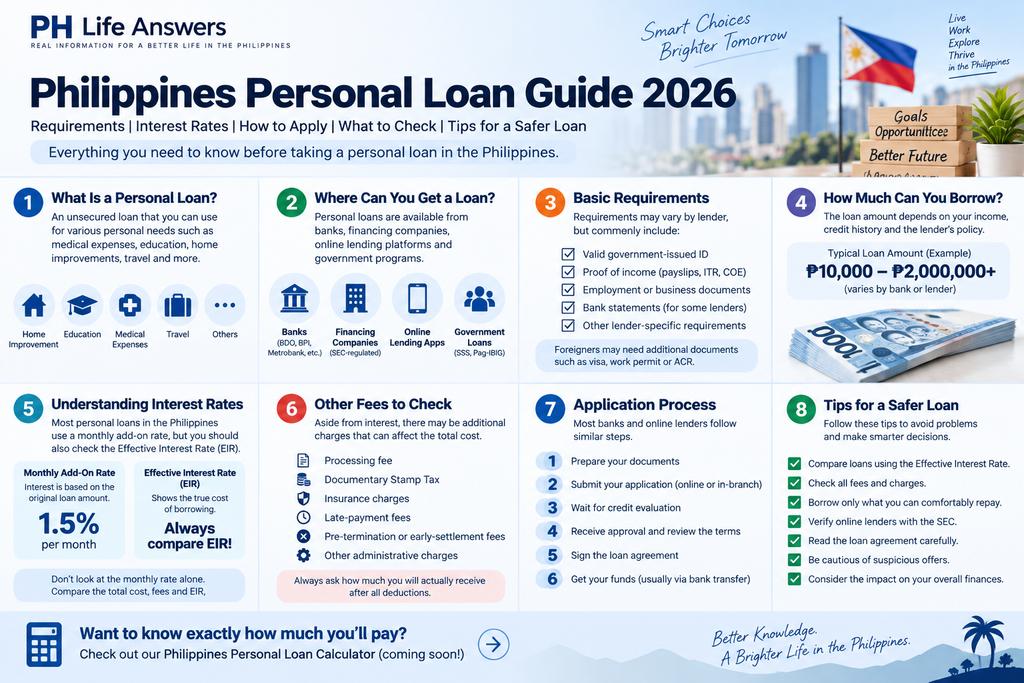
What Is a Monthly Add-On Rate?
With a simplified add-on interest calculation, interest is calculated using the original loan amount rather than the declining balance.
For example:
Loan amount:
₱100,000
Monthly add-on rate:
1.5%
Term:
12 months
The simplified interest calculation would be:
₱100,000 × 1.5% × 12
= ₱18,000 interest
Total repayment:
₱100,000 + ₱18,000
= ₱118,000
Monthly payment would therefore be approximately:
₱9,833.33
But this still doesn’t necessarily tell you the true cost of the loan.
What Is the Effective Interest Rate (EIR)?
The Effective Interest Rate, or EIR, is extremely important when comparing loans.
According to the BSP, the EIR reflects the true cost of a loan, and comparing EIRs can help borrowers evaluate competing loan products and their ability to repay.
The calculation considers the timing of repayments and can also reflect relevant finance charges.
This is why a loan advertised with a seemingly low monthly rate may have a substantially higher effective annual borrowing cost.
A useful rule:
Do not compare loans using the advertised monthly rate alone.
Compare:
- Effective Interest Rate
- Monthly payment
- Total interest
- Fees and charges
- Total repayment amount
- Actual cash you will receive
Don’t Forget Processing Fees and Other Charges
Suppose a lender approves a:
₱100,000 loan
but deducts:
₱2,000 in fees
You may actually receive only:
₱98,000
Yet your repayment obligations may still be calculated based on the approved loan amount.
That difference affects the real cost of borrowing.
The Philippine Truth in Lending Act (Republic Act No. 3765) was established specifically to require disclosure of finance charges associated with credit transactions.
BSP rules also require relevant loan disclosures, including information such as the amount financed, finance charges, net proceeds and the applicable effective interest rate for consumer credit.
So before signing a loan contract, ask:
How much money will actually be deposited into my account?
Not just:
How much am I borrowing?
Other Fees You Should Check
Depending on the lender, a personal loan may involve:
- Processing fees
- Documentary Stamp Tax
- Insurance charges
- Late-payment fees
- Penalty charges
- Pre-termination or early-settlement fees
- Other administrative charges
For example, BDO currently lists a processing fee and other possible charges for its Personal Loan, including fees relating to early full repayment.
This is another reason why two loans with identical advertised interest rates may cost different amounts.
Can You Pay a Personal Loan Early?
Often yes, but check the contract.
Early repayment does not always mean you can simply pay the remaining principal without additional charges.
Some lenders impose pre-termination or administrative fees.
BSP regulations allow banks to impose reasonable administrative costs in certain early-payment situations, provided applicable fees and conditions are properly disclosed.
If you think you may repay your loan early, check this condition before signing the agreement.
Can Foreigners Get Personal Loans in the Philippines?
Sometimes—but the rules vary considerably by bank.
This is an important point for expatriates living in the Philippines.
For example, BDO currently states that its Personal Loan applicant may be either:
a Filipino citizen or a foreigner who is a resident of the Philippines.
Foreign applicants may be asked for additional immigration or employment documents such as a valid visa, work permit, ACR or related residency documentation.
BPI, on the other hand, currently states that its Personal Loan is available to Filipino citizens residing in the Philippines, and specifically says that a foreigner married to a Filipino is not currently eligible for its regular Personal Loan.
So there is no simple rule that says:
“Foreigners can get personal loans in the Philippines.”
or
“Foreigners cannot get loans in the Philippines.”
It depends on the lender and the specific product.
We will cover loans for foreigners in the Philippines in a separate guide.
Bank Loan vs Online Loan App: Which Is Better?
Neither option is automatically better for everyone.
A traditional bank may be better if:
- You have stable employment or documented income
- You have a good credit history
- You need a larger loan
- You prefer longer repayment terms
- You are not in an immediate rush
An online lender may appeal to borrowers who:
- Need smaller amounts
- Want faster digital applications
- Prefer fewer physical branch visits
But convenience should never replace proper comparison.
Before using an online lending platform, verify:
- Who actually operates the platform?
- Is the company properly authorized?
- Is the online platform properly recorded with the SEC?
- What is the EIR?
- What fees will be deducted?
- What are the penalties for late payment?
- What information does the app request from your phone?
- What happens if you pay early?
The SEC maintains information concerning lending and financing companies, recorded online lending platforms, suspended or revoked companies and public advisories.
Warning Signs of a Suspicious Loan Offer
Be cautious if a lender:
- Contacts you unexpectedly through social media
- Guarantees approval before reviewing your information
- Refuses to clearly disclose interest and fees
- Uses another company’s SEC registration details
- Asks you to transfer money to an unrelated personal account
- Pressures you to act immediately
- Cannot clearly identify the actual lending company
- Requests unusual access to personal information
This is especially important because the SEC continues to issue public warnings involving unauthorized entities and fraudulent platforms impersonating legitimate companies.
Checklist Before Taking a Personal Loan
Before signing anything, write down these numbers:
1. Approved Loan Amount
How much are you technically borrowing?
2. Net Loan Proceeds
How much money will you actually receive after deductions?
3. Monthly Payment
Can your monthly budget comfortably handle it?
4. Number of Payments
How long will you be paying?
5. Total Repayment
How much money will leave your pocket from start to finish?
6. Effective Interest Rate
What is the actual borrowing cost?
7. Fees
Processing fee? Documentary Stamp Tax? Insurance?
8. Late-Payment Penalties
What happens if your payment is late?
9. Early-Repayment Charges
What happens if you want to settle the loan early?
If a lender cannot clearly explain these numbers, think carefully before proceeding.
How to Compare Two Loans Properly
Imagine Loan A advertises:
1.2% monthly interest
while Loan B advertises:
1.4% monthly interest.
It might seem obvious that Loan A is cheaper.
But what if Loan A deducts much higher processing fees?
What if its repayment period is different?
What if the interest calculation method is different?
What if Loan B has no major upfront deduction?
This is why comparing headline rates alone can be misleading.
The better comparison is:
Net cash received → Monthly payment → Total repayment → Effective Interest Rate
Philippines Loan Calculator – Coming Next
Calculating these numbers manually can become confusing, especially when fees and different interest-rate methods are involved.
That is why we are also preparing a Philippines Personal Loan Calculator for PH Life Answers.
You will be able to enter:
- Loan amount
- Monthly interest rate
- Loan term
- Processing fee
and automatically see estimates for:
- Monthly payment
- Total interest
- Total repayment
- Net proceeds
- Effective borrowing cost
→ Philippines Loan Calculator 2026 – Calculate Monthly Payment, Interest & EIR
Once the calculator is published, this section can be linked directly to it.
Final Thoughts
Taking a personal loan is not necessarily a bad financial decision.
A loan can be useful when it solves a genuine financial need and the repayment comfortably fits your budget.
The problem starts when borrowers focus only on:
“How much can I borrow?”
instead of:
“How much will this loan actually cost me?”
Before accepting any personal loan in the Philippines, compare the Effective Interest Rate, fees, net proceeds, monthly payment and total repayment amount.
And when dealing with online lenders, always verify that you are dealing with the legitimate company and platform—not simply an app or social-media account using a familiar name.
A few minutes spent checking the numbers before borrowing can save you months—or even years—of unnecessary financial stress.
Frequently Asked Questions
What is the easiest personal loan to get in the Philippines?
There is no single easiest lender because approval depends on income, employment, credit history and the lender’s own credit policies. Online lenders may offer faster applications, but borrowers should compare the total cost and verify the lender’s legitimacy before borrowing.
How much salary do I need for a personal loan?
It depends on the bank or lender. Some Philippine banks currently accept applications starting from relatively modest monthly income levels, while others require substantially higher income or additional employment history.
Can I get a personal loan without collateral?
Yes. Many personal loans in the Philippines are unsecured and therefore do not require property as collateral. Approval instead depends largely on your ability and history of repaying debt.
Does credit history affect loan approval in the Philippines?
Yes. Philippine lenders increasingly use credit information when evaluating applications. The Credit Information Corporation maintains the country’s centralized public credit-information repository.
What is monthly add-on interest?
Monthly add-on interest generally calculates the interest charge using the original loan amount. It should not be confused with the Effective Interest Rate.
What is EIR?
EIR means Effective Interest Rate. It is intended to reflect the actual cost of borrowing more accurately than looking at the advertised monthly rate alone. The BSP recommends using EIR when comparing loans.
Can foreigners apply for a personal loan in the Philippines?
Some lenders allow resident foreigners to apply while others restrict their products to Filipino citizens. Eligibility must be checked with the specific bank or lender.
How do I know whether an online lender is legitimate?
Identify the company operating the platform and verify its status through the Securities and Exchange Commission. Also check SEC advisories and information on recorded online lending platforms before providing personal information or borrowing money.
Information in this article is for general educational purposes and does not constitute financial or legal advice. Loan products, rates, fees and eligibility requirements may change. Always verify current terms directly with the financial institution before applying.
1 thought on “How to Get a Personal Loan in the Philippines in 2026: Requirements, Interest Rates & Complete Guide”