
Updated: September 5, 2026
President Ferdinand Marcos Jr. has signed Republic Act No. 12325, a major amendment to the Philippines’ Universal Access to Quality Tertiary Education Act or Republic Act No. 10931.
The new law was formally signed at Malacañang Palace on September 4, 2026.
RA 10931, passed in 2017, established free tuition and other school fees in State Universities and Colleges (SUCs), Local Universities and Colleges (LUCs), and state-run technical-vocational institutions.
Republic Act 12325 does not replace that system.
Instead, it strengthens it by putting greater emphasis on poor and disadvantaged students, expanding the Tertiary Education Subsidy (TES), and providing new assistance for qualified students studying in certain private institutions.
So what exactly changes under RA 12325?
Here is what Filipino students and families need to know.
What Is Republic Act 12325?
Republic Act No. 12325 is officially titled:
“An Act Enhancing the Universal Access to Quality Tertiary Education Act.”
It amends Republic Act No. 10931, commonly known as the Free Tuition Law or Universal Access to Quality Tertiary Education Act.
The original RA 10931 created several major education assistance programs, including:
- Free Higher Education in public universities and colleges
- Free Technical-Vocational Education and Training
- Tertiary Education Subsidy or TES
- Student Loan Programs
The problem, however, was that free tuition alone did not eliminate all the financial barriers facing students.
Students still have to pay for transportation, food, books, accommodation, internships, clinical training and other expenses necessary to finish their studies.
RA 12325 attempts to address more of those costs while making government assistance more targeted toward students who need it most.
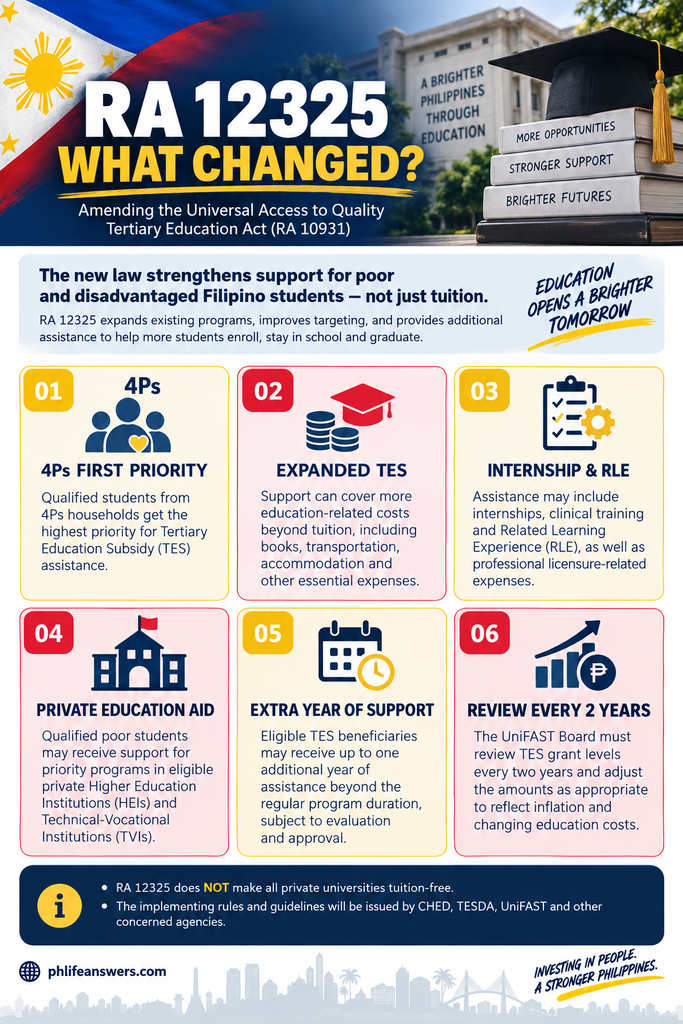
1. 4Ps Students Get Top Priority for Tertiary Education Subsidies
One of the biggest changes under RA 12325 involves the Tertiary Education Subsidy (TES).
Under the amended system, students belonging to households enrolled in the Pantawid Pamilyang Pilipino Program (4Ps) will receive the highest priority for available TES assistance.
After qualified 4Ps beneficiaries, remaining slots will generally be allocated according to household income.
This is an important change because government studies previously found that the poorest families were not always receiving the largest share of TES assistance.
According to the Second Congressional Commission on Education (EDCOM II), the share of TES grants going to the poorest households dropped from 74.24% in 2018 to 30.74% in 2022.
RA 12325 is intended to reverse that trend by directing limited government assistance toward the most financially disadvantaged students first.
2. TES Can Cover More Than Just Basic School Expenses
RA 12325 also expands the types of educational expenses that may be supported through the Tertiary Education Subsidy.
This is particularly important for students whose programs require additional practical training.
Expanded assistance may include costs related to:
- Internships
- Related Learning Experience or RLE
- Clinical or practical training
- Professional licensure-related expenses
- Additional allowances for students with disabilities
The inclusion of Related Learning Experience expenses is especially relevant to nursing and allied health students, who can face significant additional costs for mandatory clinical training.
Previously, these expenses could still become a major financial burden even when a student’s tuition was already covered.
3. Students May Receive Up to One Additional Year of Support
Not every student is able to complete a degree exactly within the standard program duration.
Financial hardship, illness, natural disasters and other unexpected circumstances can delay graduation.
Under the enhanced law, eligible TES beneficiaries may be allowed to receive assistance for up to one additional year beyond the regular duration of their program, subject to evaluation and approval.
This is an important shift from simply helping students enter college toward helping them actually finish their education.
4. New Assistance for Qualified Students in Private Colleges and TVIs
Another significant change is the creation of a Private Education Assistance (PEA) program.
This can provide government assistance to poor and deserving students pursuing designated priority programs in qualified:
- Private Higher Education Institutions (HEIs)
- Private Technical-Vocational Institutions (TVIs)
The program is intended to give disadvantaged students more options when the degree or training program they need may not be available through nearby public institutions.
Does this mean all private colleges are now free?
No.
This is one of the most important distinctions to understand.
RA 12325 does not make tuition free for every student attending every private university in the Philippines.
Assistance will apply to qualified or disadvantaged students and eligible priority programs at participating or qualified institutions, subject to the implementing rules, available funding and government eligibility requirements.
5. TES Amounts Must Be Reviewed Every Two Years
Education costs do not remain constant.
Transportation, accommodation, food, school materials and other expenses increase over time because of inflation.
RA 12325 therefore requires the UniFAST Board to regularly review TES grant levels.
The subsidy amounts must be reviewed every two years and adjusted as appropriate to reflect inflation and changing educational costs.
This should prevent student financial assistance from gradually losing its value simply because living and education expenses increase.
6. Public Schools Must Introduce Equity and Inclusion Measures
RA 12325 goes beyond simply distributing subsidies.
State Universities and Colleges, Local Universities and Colleges, and state-run technical-vocational institutions will also be required to develop Equity and Inclusion Plans for disadvantaged learners.
Possible measures may include:
- Waiving certain admission examination fees
- Providing assistive technologies
- Improving accessibility for students with disabilities
- Giving disadvantaged students priority access to available dormitories and facilities
- Other measures intended to help vulnerable students enroll and remain in school
This means the reform focuses not only on tuition but also on practical barriers that can prevent disadvantaged students from completing their education.
7. Government Will Improve Student Tracking and Accountability
RA 12325 also introduces additional mechanisms intended to improve how education assistance is monitored.
One is the development of a single learner reference code, which can help government agencies track beneficiaries as they move from secondary education into higher education or technical-vocational training.
CHED and TESDA will also establish formal mechanisms for handling complaints from students.
In addition, government agencies will be required to submit comprehensive reports to Congress covering areas such as:
- Program outcomes
- Budget utilization
- Student beneficiaries
- Employment outcomes and tracer studies
These provisions are intended to make the massive government tertiary education assistance system easier to monitor and evaluate.
RA 10931 vs RA 12325: What Changed?
| Area | RA 10931 | RA 12325 |
|---|---|---|
| Free tuition in SUCs and LUCs | Yes | Continues |
| Free training in state-run TVIs | Yes | Continues |
| Tertiary Education Subsidy | Yes | Expanded |
| Priority for poorest students | Existing prioritization | Stronger targeting, including 4Ps priority |
| Internship/RLE support | Limited | Expanded |
| Licensure-related assistance | Limited | Expanded |
| PWD allowances | Existing assistance mechanisms | Additional support strengthened |
| Private education assistance | Limited TES access | New Private Education Assistance mechanism |
| TES adjustment | Existing system | Review every two years |
| Additional year of TES | Limited | May be allowed under justified circumstances |
| Equity and Inclusion Plans | Not a major requirement | Required |
| Monitoring/accountability | Existing mechanisms | Strengthened |
Why Was RA 12325 Needed?
The Philippines has already significantly expanded access to public higher education.
President Marcos said the number of beneficiaries of the Free Higher Education program increased from around 2 million to approximately 2.6 million students by the first semester of the current academic year.
But entering college and completing college are two different things.
Even when tuition is free, financially disadvantaged students may still struggle with:
- Daily transportation
- Meals
- Rent or dormitory expenses
- Books and learning materials
- Internet and equipment
- Internship expenses
- Clinical training
- Licensure costs
For many poor families, these expenses can still force a student to stop studying.
The direction of RA 12325 is therefore clear:
Free tuition should not simply help students enroll. Government assistance should help disadvantaged students stay in school and graduate.
What Should Students Do Now?
Students should remember that the signing of the law does not mean every new benefit will immediately become available at every university.
President Marcos has directed CHED, TESDA, UniFAST and other concerned agencies to complete the implementing rules and regulations required for RA 12325.
The detailed eligibility rules, application procedures and implementation schedules will therefore depend on the official guidelines issued by these agencies.
Students who may qualify should monitor announcements from:
- CHED
- UniFAST
- TESDA
- Their university or college
- Their local government or scholarship office
Students from 4Ps households should also make sure their household and student information is accurate and updated when applications or verification procedures begin.
Final Thoughts
Republic Act 12325 represents an important evolution of the Philippines’ free higher education program.
The original RA 10931 removed one of the biggest obstacles to higher education: tuition.
RA 12325 attempts to address the next problem:
How do students from poor families actually survive financially long enough to finish college?
By prioritizing 4Ps and other disadvantaged students, expanding TES coverage, supporting internship and training expenses, introducing assistance for selected private education programs, and strengthening accountability, the government is shifting the focus from simply providing access to helping students achieve completion.
For millions of Filipino families, that distinction could be significant.
Frequently Asked Questions
Is Republic Act 12325 a new free college law?
RA 12325 is an amendment to RA 10931, the Universal Access to Quality Tertiary Education Act. It strengthens and expands several parts of the existing free higher education system rather than replacing it.
Does RA 12325 make all private universities free?
No. The law creates additional government assistance for qualified disadvantaged students pursuing priority programs at eligible private HEIs and TVIs. It does not provide universal free tuition at all private schools.
Are 4Ps beneficiaries automatically entitled to TES?
RA 12325 gives qualified students from 4Ps households the highest priority for TES assistance. Actual qualification and distribution will still be subject to the implementing rules and applicable government requirements.
Can TES now cover nursing RLE or internship expenses?
Yes. The expanded TES framework may provide assistance for internships and Related Learning Experience expenses, including mandatory practical and clinical training associated with programs such as nursing and allied health courses.
Can students receive TES if their graduation is delayed?
Qualified beneficiaries who cannot finish within the normal program period because of justified circumstances may be allowed up to one additional year of assistance, subject to evaluation and approval.
When will the new RA 12325 benefits become available?
CHED, TESDA and UniFAST still need to implement the law through the required rules and guidelines. Students should wait for official announcements regarding application procedures, eligibility and implementation schedules.