A foreign national can obtain a Philippine driver’s license even without holding a driver’s license from another country.
However, the process is different from converting a valid foreign driver’s license.
A foreigner applying as a new driver must complete the full Philippine licensing process, including the Theoretical Driving Course, Student-Driver’s Permit, Practical Driving Course, and the required LTO examinations.
Foreign applicants must also satisfy additional passport and immigration requirements.
This guide explains how a foreign national can obtain a new non-professional Philippine driver’s license from scratch in 2026.
Already have a valid foreign driver’s license?
The conversion procedure is usually shorter and follows a different set of requirements. This article is only for applicants who are obtaining a Philippine driver’s license as a new driver.
Philippine Driver’s License Process for Foreigners
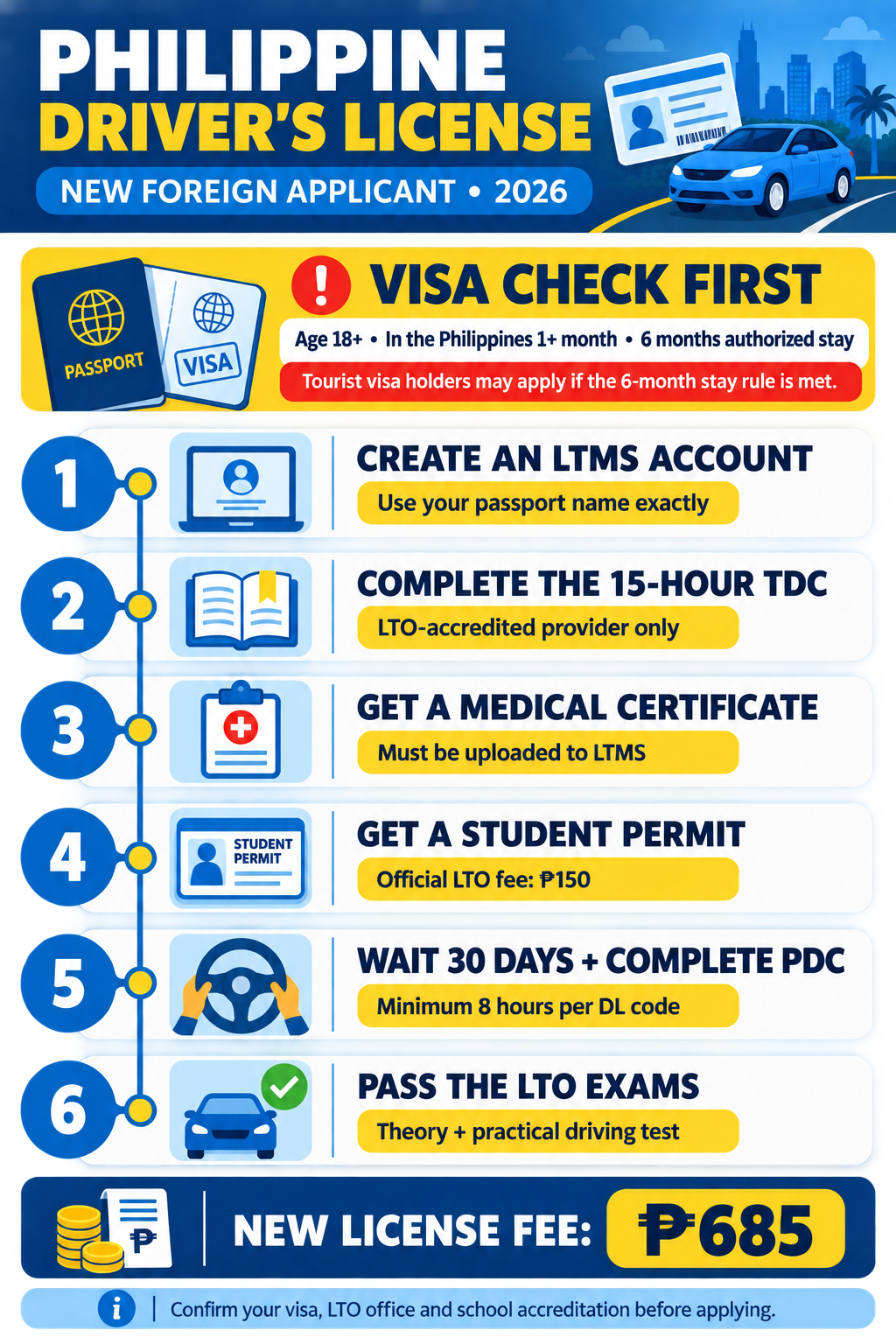
A foreign applicant generally needs to complete the following steps:
- Confirm that the passport and visa meet the LTO requirements.
- Create an LTMS Portal account.
- Complete the 15-hour Theoretical Driving Course.
- Obtain an LTO-accredited medical certificate.
- Apply for a Student-Driver’s Permit.
- Complete the Practical Driving Course.
- Hold the Student-Driver’s Permit for at least 30 days.
- Apply for a non-professional driver’s license.
- Pass the required theoretical and practical examinations.
- Pay the license fee and claim the license.
The process cannot normally be completed within a few days because the Student-Driver’s Permit must be held for at least 30 days before the applicant can apply for the full non-professional license.
Who Can Apply?
A foreign national applying for a Student-Driver’s Permit must generally meet the following qualifications:
- At least 18 years old
- Physically and mentally fit to operate a motor vehicle
- Able to read and write in English or Filipino
- No unsettled traffic violations
- Has been in the Philippines for at least one month
- Can provide proof of authorized stay for at least six months from the application date
- Has completed the required Theoretical Driving Course
- Has an LTMS Client ID
- Has an active email address
The immigration requirement is one of the most important differences between Filipino and foreign applicants.
Can a Tourist Visa Holder Apply?
Yes.
A foreign national holding a Temporary Visitor Visa, commonly known as a 9(a) tourist visa, may apply for a Philippine driver’s license as a new driver.
The LTO does not limit the application to holders of work, immigrant, retirement, or permanent-resident visas.
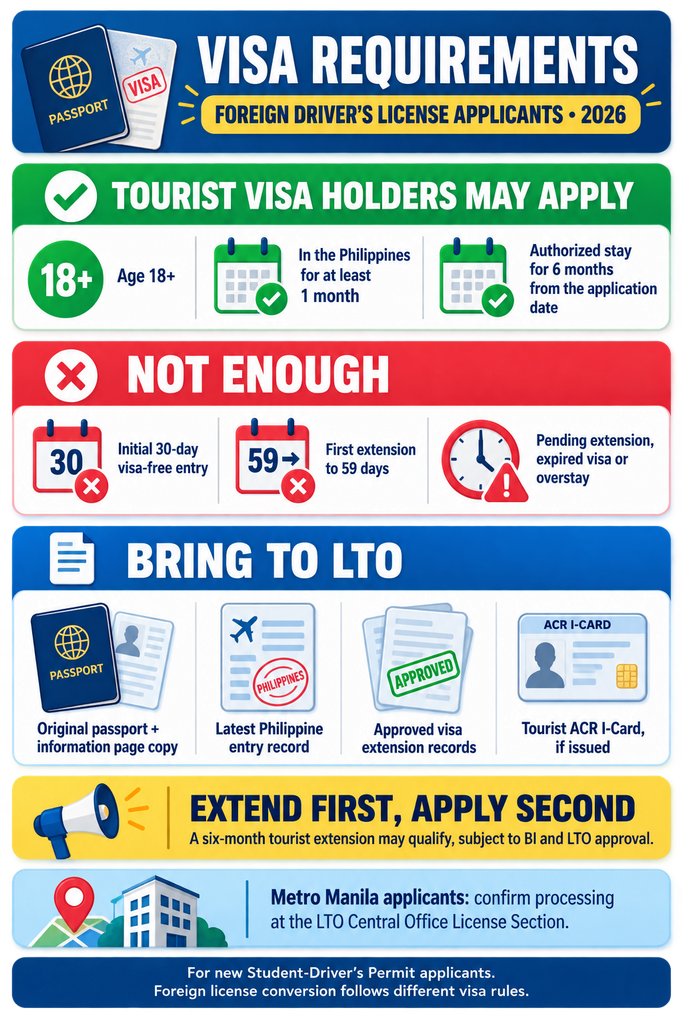
However, simply holding a tourist visa is not enough.
For a Student-Driver’s Permit, the foreign applicant must:
- Have already been in the Philippines for at least one month; and
- Show proof of authorized stay covering at least six months from the application date.
The LTO’s current foreign-applicant checklist requires a passport showing an entry date of at least one month and a visa duration of six months from the application date.
Initial Visa-Free Entry Is Not Enough
Many foreign visitors initially receive a 30-day visa-free stay.
That initial admission period does not satisfy the LTO requirement because the applicant cannot show six months of authorized stay from the Student-Driver’s Permit application date.
The first visa-waiver extension, which normally brings the total authorized stay to 59 days, is also insufficient.
A tourist will generally need a longer extension of authorized stay before applying.
Can a Tourist Obtain a Six-Month Extension?
The Bureau of Immigration allows eligible temporary visitors to apply for one-month, two-month, or six-month extensions.
A six-month extension may be available through the Long-Stay Visitor Visa Extension program, subject to Bureau of Immigration approval.
A tourist applicant should complete the extension before visiting the LTO.
A pending extension application may not be accepted as proof of authorized stay.
Visa Status at a Glance
| Immigration status | Student permit eligibility |
|---|---|
| Initial 30-day visa-free entry | Does not meet the six-month requirement |
| First extension bringing the total stay to 59 days | Still insufficient |
| One- or two-month tourist extension | Insufficient unless the remaining authorized stay covers the full LTO requirement |
| Approved six-month tourist extension | Potentially eligible if it covers six months from the application date |
| Valid 9(g), 13(a), SRRV, student or other long-term status | Generally eligible if the remaining authorized stay satisfies the requirement |
| Expired visa or overstaying status | Not eligible until the immigration status is resolved |
The final decision remains with the processing LTO office after reviewing the passport and Bureau of Immigration records.
Tourist ACR I-Card Requirements
Foreign tourists who stay in the Philippines for more than 59 days are generally required to obtain a Tourist ACR I-Card.
The ACR I-Card application is normally processed together with the applicable tourist visa extension.
A tourist applying for a Student-Driver’s Permit should bring the ACR I-Card if it has already been issued.
However, the ACR I-Card should be treated as a supporting document. It does not replace the passport and visa records required by the LTO.
Immigration Documents a Tourist Should Bring
A tourist applicant should prepare:
- Original passport
- Photocopy of the passport information page
- Passport page showing the latest Philippine entry
- Current visa-extension stamp or authorized-stay record
- Bureau of Immigration approval or official receipt for an online extension
- Tourist ACR I-Card, if already issued
- Photocopies of recent visa extensions
Applicants should maintain valid immigration status throughout the licensing process, including the mandatory waiting period between the Student-Driver’s Permit and the full driver’s-license application.
Step 1: Create an LTMS Portal Account
The Land Transportation Management System, or LTMS, is the LTO’s online platform for driver licensing and other transactions.
Create a personal account through the official portal:
Select Register Now and complete the required information.
When registering:
- Use an active email address that you personally control.
- Enter your full name exactly as it appears in your passport.
- Enter the correct birth date and nationality.
- Do not abbreviate or rearrange your name unless the system requires it.
- Save your LTO Client ID.
Your LTMS Client ID connects your driving-school certificates, medical certificate, examinations, and driver’s-license application.
A spelling difference between the passport, LTMS account, medical certificate, and driving-school records can prevent the electronic records from matching.
Step 2: Complete the 15-Hour Theoretical Driving Course
Before applying for a Student-Driver’s Permit, you must complete the mandatory 15-hour Theoretical Driving Course, commonly called the TDC.
The course covers subjects such as:
- Philippine traffic laws
- Road signs and pavement markings
- Right-of-way rules
- Defensive driving
- Road courtesy and discipline
- Vehicle safety inspection
- Basic vehicle operation
- Parking and driving maneuvers
- Emergency procedures
- Duties and responsibilities of a driver
The TDC must be completed through:
- An LTO Driver’s Education Center; or
- A driving school currently accredited by the LTO
The school must register the applicant using the LTMS Client ID and electronically transmit the Certificate of Completion to the LTO system.
A printed certificate alone is not enough if the electronic record does not appear in LTMS.
Before paying a driving school, confirm that:
- Its LTO accreditation is active.
- It accepts foreign applicants.
- It can register you using your LTMS Client ID.
- It will electronically transmit your TDC certificate.
Important Change Affecting TESDA Certificates
Foreign applicants should be careful when enrolling in a TESDA-affiliated driving program.
In August 2025, the LTO rescinded the general equivalency between TESDA driving certificates and the LTO’s required driving courses.
This means that a TESDA certificate is no longer automatically accepted as an LTO Theoretical or Practical Driving Course certificate.
A TESDA institution may issue an acceptable certificate only if it is also properly accredited by the LTO as a driving school.
Do not rely only on a TESDA logo or TESDA registration.
Ask the institution to show its current LTO accreditation and confirm that it can transmit the course certificate to LTMS.
TDC Assessment
The TDC includes examinations covering Philippine traffic laws, road signs, defensive driving, vehicle operation, and other subjects discussed during the course.
The LTO driver-education rules prescribe an 80% passing standard for the required TDC assessment and validation process.
After completing the course and passing the assessment, the provider should issue the TDC Certificate of Completion and electronically transmit it to LTMS.
Step 3: Get an LTO-Accredited Medical Certificate
The applicant must undergo a medical examination at an LTO-accredited medical clinic.
Many accredited clinics are located near LTO offices, but applicants should confirm that the clinic’s accreditation remains active.
The medical examination may include checks of:
- Eyesight
- Hearing
- Blood pressure
- Physical condition
- Medical history
- Ability to operate a motor vehicle safely
The clinic must electronically transmit the result to the LTO system.
Ask for a printed copy of the medical certificate as well.
Before leaving the clinic, check that the following details are correct:
- Full name
- Birth date
- Nationality
- Passport information
- LTMS Client ID
Medical examination fees are not uniform nationwide.
Although a ₱300 standard medical fee was previously proposed, its implementation was officially placed on hold. Confirm the current price with the clinic before proceeding.
Step 4: Prepare the Student-Driver’s Permit Requirements
Prepare the original and at least one clear photocopy of each applicable document.
The standard requirements include:
- Application for Permits and Licenses form, if requested
- Electronically transmitted medical certificate
- Printed copy of the medical certificate
- Valid passport
- Photocopy of the passport information page
- Passport page showing the latest Philippine entry
- Current visa or proof of authorized stay
- Proof that the applicant has been in the Philippines for at least one month
- Proof of authorized stay covering at least six months from the application date
- Tourist ACR I-Card or other ACR I-Card, if applicable
- Another issued ID with a photograph and signature, if available
- TDC Certificate of Completion
- Confirmation that the TDC record appears in LTMS
- LTO Client ID
- Taxpayer Identification Number, or TIN, if employed in the Philippines
A foreign national born in the Philippines may also be required to present a PSA-authenticated birth certificate.
Bring extra photocopies of the passport information page, latest entry, visa extension, ACR I-Card, and other immigration documents.
Where Should a Foreign Applicant Apply?
Do not assume that every LTO office processes first-time foreign applicants.
Many mall-based Driver’s License Renewal Offices mainly handle renewals and simple transactions. They may not process new Student-Driver’s Permits or administer the examinations required for a new driver’s license.
LTO-NCR currently directs foreign Student-Driver’s Permit applicants residing in Metro Manila to the License Section at the LTO Central Office.
Foreign applicants residing outside Metro Manila may apply through licensing centers or district and extension offices authorized by the relevant LTO regional office.
Before visiting, confirm that the office processes:
- New Student-Driver’s Permits for foreign nationals
- New non-professional driver’s licenses
- Automated theoretical examinations
- Practical driving examinations
Step 5: Apply for the Student-Driver’s Permit
Submit the documents at the authorized LTO office.
The usual procedure includes:
- Obtaining a queue number
- Submitting the application and documentary requirements
- Verification of the passport and visa
- Verification of the medical and TDC records in LTMS
- Photo, signature, and biometric capture
- Completion of the applicable validation process
- Payment
- Release of the Student-Driver’s Permit
The updated 2025 LTO Citizen’s Charter lists the Student-Driver’s Permit fee at:
₱150
This amount does not include:
- TDC tuition
- Medical examination
- Visa extension
- ACR I-Card
- Photocopying
- Transportation
- Other incidental expenses
A Student Permit Is Not a Full Driver’s License
A Student-Driver’s Permit does not allow you to drive alone.
A student driver must be accompanied by a duly licensed driver who holds the proper driver’s-license code for the type of vehicle being operated.
Driving alone with only a Student-Driver’s Permit may be treated as driving without a valid driver’s license.
The Student-Driver’s Permit is generally valid for one year from its issuance date.
Step 6: Complete the Practical Driving Course
After receiving the Student-Driver’s Permit, enroll in the Practical Driving Course, commonly called the PDC.
The course must be completed through:
- An LTO Driver’s Education Center; or
- An LTO-accredited driving school
Practical instruction must be at least eight hours for each driver’s-license code being applied for.
For an ordinary private passenger car, applicants normally apply for DL Code B.
The PDC generally includes:
- Pre-driving vehicle inspection
- Starting and stopping
- Steering and vehicle control
- Lane changing
- Turning and intersection procedures
- Uphill and downhill driving
- Reversing
- Parking
- Driving in traffic
- Defensive driving
- Hazard recognition
- Emergency procedures
The school must electronically transmit the PDC Certificate of Completion to LTMS.
Manual or Automatic Transmission
Tell the driving school whether you intend to drive a manual or automatic vehicle.
The vehicle and transmission used during training and testing can affect the authority recorded on the license.
If the course and examination are completed using only an automatic vehicle, the license may be restricted accordingly.
Confirm the correct driver’s-license code and transmission condition before the school uploads the certificate.
Practical Driving Examination Center Update
The LTO introduced standardized Practical Driving Examination Center procedures in October 2025.
Where the PDEC system applies, an applicant must pass the final practical driving examination before the PDC is considered complete.
Only after passing the final examination can the accredited driving school issue and upload the PDC Certificate of Completion.
The PDEC assessment may cover:
- Pre-driving safety checks
- Proper use of mirrors and signals
- Vehicle control
- Lane discipline
- Stopping and right-of-way
- Parking
- Road-sign compliance
- Safe interaction with pedestrians and other vehicles
An applicant who fails the PDEC practical examination must generally wait seven calendar days before retaking it.
PDEC implementation can differ by region.
Ask the driving school and LTO office:
- Where the final practical examination will take place
- Whether a designated PDEC is used
- Whether the PDEC result will be credited to the final license application
- Whether another practical examination will be required at the LTO office
Step 7: Wait at Least 30 Days
The Student-Driver’s Permit holder cannot immediately apply for the non-professional driver’s license.
The permit must be held for at least 30 days from its issuance date.
During this period, the applicant may complete the PDC and prepare for the theoretical and practical examinations.
Remember that a student driver may only practice while accompanied by a duly licensed driver with the correct vehicle code.
Step 8: Apply for the Non-Professional Driver’s License
Once at least 30 days have passed and the PDC has been completed, the applicant may apply for a new non-professional driver’s license.
Prepare:
- Valid Student-Driver’s Permit
- Electronically transmitted medical certificate
- Printed medical certificate
- Original and photocopy of the PDC Certificate of Completion
- Confirmation that the PDC record appears in LTMS
- Passport
- Current visa and immigration records
- ACR I-Card, if applicable
- LTMS Client ID
- Online application or appointment details
- TIN, if employed
- Application form, if required
The applicant must:
- Be at least 18 years old
- Be physically and mentally fit
- Be able to read and write in English or Filipino
- Have no unsettled traffic violations
- Have held the Student-Driver’s Permit for at least 30 days
- Pass the required theoretical and practical examinations
What Happens at the LTO Office?
The normal new-license process includes:
- Documentary evaluation
- Verification of LTMS records
- Photo, signature, and biometric verification
- Automated theoretical examination
- Practical driving examination or verification of an applicable PDEC result
- Payment
- License printing and release
Automated Theoretical Examination
The LTO theoretical examination covers subjects such as:
- Traffic signs and signals
- Road markings
- Right-of-way rules
- Parking rules
- Speed limits
- Defensive driving
- Driver responsibilities
- Road safety
- Traffic violations
- Emergency procedures
Foreign applicants can take the examination in English.
The official LTO Driver’s Manual and the lessons covered during the TDC are safer study references than unofficial online reviewers.
Practical Driving Examination
Depending on the office and applicable PDEC procedure, the applicant may need to complete a practical driving test.
The examination may include:
- Pre-driving inspection
- Starting and stopping safely
- Proper mirror use
- Use of turn signals
- Lane positioning
- Turning
- Reversing
- Parking
- Right-of-way
- Obeying traffic signs
- General vehicle control
Ask whether:
- A test vehicle is available
- A vehicle can be rented
- You must provide your own vehicle
- The vehicle must match the license code and transmission being applied for
Step 9: Pay the License Fee
The updated 2025 LTO Citizen’s Charter lists the government charge for a new non-professional driver’s license at:
₱685
The published fixed LTO fees are:
| Government transaction | Published fee |
| Student-Driver’s Permit | ₱150 |
| New non-professional driver’s license | ₱685 |
| Total fixed LTO fees | ₱835 |
These amounts do not include:
- Medical examination
- TDC tuition
- PDC tuition
- PDEC or practical-test charges
- Test-vehicle rental
- Visa extension
- ACR I-Card
- Photocopying and transportation
Ask the driving school for a written price breakdown before paying.
A low advertised course fee may not include the complete required hours, vehicle use, assessment, certificate processing, or LTMS upload.
Check the License Before Leaving
Once approved, check the following information:
- Full name
- Birth date
- Nationality
- Address
- Driver’s-license code
- Transmission condition
- Expiration date
Report any error immediately.
Can Foreigners Use the Electronic Driver’s License?
Yes.
The LTO confirmed in January 2026 that the official electronic driver’s license available through the LTMS Portal or eGovPH can be presented to authorized traffic enforcers.
However, it should be displayed directly from the official account.
A screenshot, saved image, photocopy, or edited digital copy is not treated as the official electronic driver’s license.
How Long Does the Process Take?
| Stage | Estimated timing |
| Visa preparation or extension | Depends on immigration status |
| LTMS registration | Same day |
| TDC | Several scheduled sessions |
| Medical examination | Same day |
| Student-Driver’s Permit | One processing day if documents are complete |
| Mandatory permit holding period | At least 30 days |
| PDC and practical assessment | Several scheduled sessions |
| Final LTO application | One processing day if all requirements are complete |
The licensing process cannot normally be completed in less than one month after the Student-Driver’s Permit is issued.
Approximately five to eight weeks is a reasonable planning period after the passport and immigration requirements are ready.
Common Mistakes Foreign Applicants Should Avoid
1. Confusing a New Application With Foreign-License Conversion
A new applicant must complete the TDC, Student-Driver’s Permit, PDC, waiting period, and required examinations.
2. Applying With Insufficient Visa Validity
Being in the Philippines for one month is not enough.
The applicant must also provide proof of authorized stay covering at least six months from the Student-Driver’s Permit application date.
3. Assuming a 59-Day Tourist Stay Is Enough
The first visa-waiver extension normally provides only 59 days of total authorized stay and does not meet the six-month LTO requirement.
4. Submitting a Pending Visa Extension
Complete the immigration extension before applying and bring proof of approval.
5. Relying Only on the ACR I-Card
The ACR I-Card does not replace the passport, latest entry record, and current visa documents.
6. Enrolling With a Non-Accredited Driving School
A printed certificate is not enough if the provider cannot transmit it to LTMS.
7. Assuming Any TESDA Certificate Is Accepted
The institution must also be accredited by the LTO as a driving school.
8. Entering Different Names in Different Records
The passport, LTMS account, medical certificate, and driving-school records should show the same name and birth date.
9. Going to a Renewal-Only Office
Confirm that the selected office processes first-time foreign applicants and conducts the required examinations.
10. Driving Alone With a Student Permit
A student driver must be accompanied by a duly licensed driver with the correct vehicle code.
11. Applying for the Full License Too Early
Wait at least 30 days from the Student-Driver’s Permit issuance date.
12. Selecting the Wrong Vehicle Code or Transmission
Make sure the PDC and examination records match the vehicle and transmission you intend to drive.
Frequently Asked Questions
Can a tourist obtain a Philippine driver’s license?
Yes, provided that the tourist has already been in the Philippines for at least one month and can show authorized stay covering at least six months from the Student-Driver’s Permit application date.
The initial 30-day admission or first extension to 59 days is not sufficient.
Does a tourist need an ACR I-Card?
Tourists staying in the Philippines for more than 59 days are generally required to obtain a Tourist ACR I-Card.
Bring it as a supporting document, but also bring the passport and complete visa-extension records.
Can I apply while my tourist visa extension is pending?
It is safer to wait until the extension is approved.
The LTO may require proof of an already authorized six-month stay rather than a pending application.
Can I drive alone after receiving the Student-Driver’s Permit?
No.
You must be accompanied by a duly licensed driver authorized to operate the same type of vehicle.
How soon can I apply for the non-professional license?
At least 30 days after the Student-Driver’s Permit was issued, provided that the PDC has been completed.
Do foreigners take the theoretical and practical examinations?
Yes, when applying as a new driver.
A separate procedure applies to holders converting a valid foreign driver’s license.
Can the examinations be taken in English?
Yes.
English is available for foreign applicants during the driver’s-license process and examinations.
Is a TESDA driving certificate accepted?
Only when the TESDA institution is also duly accredited by the LTO as a driving school and can transmit the certificate to LTMS.
How much are the official LTO fees?
The current published government charges are ₱150 for the Student-Driver’s Permit and ₱685 for the new non-professional driver’s license.
The combined fixed LTO charges are ₱835, excluding other expenses.
How long is a new Philippine driver’s license valid?
A new driver’s license is generally valid for five years.
A driver with no recorded traffic violations during the relevant period may qualify for a 10-year license upon renewal.
What if I already have a valid foreign driver’s license?
Use the foreign-license conversion procedure instead of starting with a Student-Driver’s Permit.
That process has different visa, documentary, and examination requirements.
Final Reminder
Before paying for a course or visiting the LTO, confirm:
- Passport and visa eligibility
- Six-month authorized-stay requirement
- Driving school’s current LTO accreditation
- Electronic transmission of TDC and PDC certificates
- Office authorized to process foreign applicants
- PDEC or practical-test location
- Driver’s-license code
- Manual or automatic transmission condition
Requirements and local implementation procedures may change.
Always confirm the final checklist with the selected LTO office before the appointment.