Last updated: August 24, 2026
Heavy rain, flooded roads and disrupted public transportation can make commuting dangerous during the rainy season in the Philippines.
But what if your company has not suspended work?
Can you legally refuse to go to work because of heavy rain or flooding?
The short answer is yes — if the weather disturbance creates an imminent danger to your safety or health.
Under Department of Labor and Employment (DOLE) Labor Advisory No. 14, Series of 2026, workers who fail or refuse to work because of imminent danger resulting from weather disturbances or similar occurrences should not be subjected to administrative sanctions.
However, this does not mean that employees automatically have the day off whenever there is heavy rain.
Here is what employees and employers need to know.
Quick Answer: Heavy Rain and Work Rules
| Question | Answer |
|---|---|
| Can private companies suspend work? | Yes |
| Can employees refuse to report for work? | Yes, if there is imminent danger |
| Can an employee be disciplined for refusing unsafe work? | No, when the refusal is due to imminent danger |
| Do you get paid if you do not work? | Generally no — no work, no pay |
| Can leave credits be used? | Yes, if allowed |
| Worked at least 6 hours? | Full regular pay |
| Worked less than 6 hours? | Proportionate regular pay |
What Is DOLE Labor Advisory No. 14-26?
DOLE issued Labor Advisory No. 14, Series of 2026, titled:
“Suspension of Work in the Private Sector by Reason of Weather Disturbances and Similar Occurrences.”
Labor Secretary Francis N. Tolentino signed the advisory on August 19, 2026.
The new advisory provides guidelines covering:
- work suspension in private companies
- payment of wages
- use of leave credits
- employee safety
- refusal or failure to report for work because of imminent danger
DOLE said private employers may suspend work to protect the safety and health of employees during weather disturbances and similar events.
Employers are encouraged to consider official advisories from PAGASA, the NDRRMC and local government units (LGUs) when making these decisions.
Can You Refuse to Go to Work During Heavy Rain?
Yes, when there is an imminent danger to your safety or health.
The important phrase in the DOLE advisory is “imminent danger.”
This means that heavy rain by itself does not automatically give every employee the right to skip work.
The issue is whether the weather disturbance creates a genuine danger to the worker.
For example, severe flooding, dangerous road conditions or other serious weather-related hazards may create circumstances in which traveling to or performing work would put an employee at risk.
DOLE says employees who fail or refuse to work because of such imminent danger shall not be subjected to administrative sanctions.
Can Your Employer Punish You for Not Reporting to Work?
If you fail or refuse to work because there is an imminent danger caused by severe weather or a similar occurrence, DOLE says you should not face administrative sanctions.
This is an important protection for employees.
However, employees should still communicate with their employer or supervisor as soon as possible.
If your area is experiencing serious flooding or dangerous conditions, it can also be useful to keep evidence such as:
- official PAGASA warnings
- LGU advisories
- road closure notices
- photos of actual flooding in your area
- transportation suspension announcements
This can help clearly explain why traveling to work was unsafe.
Who Decides Whether a Private Company Suspends Work?
For private-sector companies, the decision to suspend work is generally made by the employer.
DOLE allows employers, in the exercise of management prerogative, to suspend work when weather disturbances or similar occurrences threaten employee safety and health.
The employer should coordinate with the company’s:
- safety and health committee
- safety officer
- or another responsible company official
Official advisories from PAGASA, NDRRMC and LGUs may be used to guide the decision.
Does Government Work Suspension Automatically Apply to Private Companies?
Not necessarily.
The suspension of work in government offices does not automatically mean that every private company is also closed.
Private employers generally make their own decision on whether operations should be suspended, unless a law, proclamation or specific government directive provides otherwise.
Employees should therefore check their company’s official announcement rather than assuming that a government work suspension automatically applies to them.
Do You Get Paid If You Cannot Work Because of Heavy Rain?
Generally, the “no work, no pay” principle applies.
If you do not perform work because operations were suspended, you normally will not receive your regular wage for that day.
However, there are exceptions.
You may still receive compensation if your company has a more favorable:
- company policy
- established practice
- collective bargaining agreement (CBA)
Employees may also be allowed to use accrued leave credits so they can still be compensated for the day.
DOLE’s 2026 advisory specifically recognizes these exceptions.
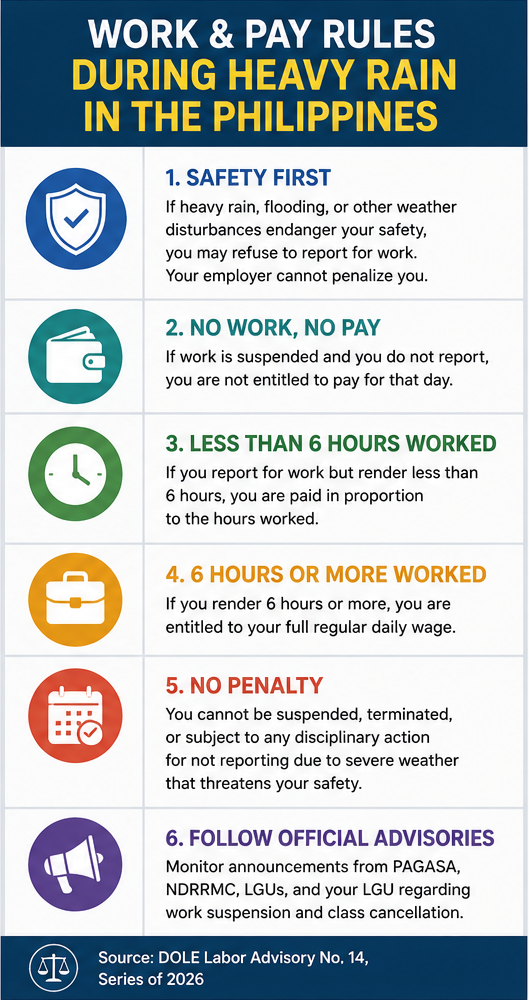
Work & Pay Rules During Heavy Rain in the Philippines
What If You Already Reported to Work?
This is where the six-hour rule becomes important.
Worked for at least 6 hours
If you report for work and complete at least six hours, you are entitled to your full regular pay for the day.
Worked for less than 6 hours
If you work for less than six hours, you are entitled to a proportionate amount of your regular pay based on the hours you actually worked.
Example
Suppose heavy rain becomes severe during the afternoon and your company allows employees to leave early.
If you have already worked six hours, you are entitled to full regular pay.
If you only worked four hours, you would generally receive proportionate pay for those four hours, unless your company provides a more favorable policy or benefit.
Can You Use Vacation or Leave Credits?
Possibly, yes.
If you cannot report for work because of bad weather, your employer may allow you to use available accrued leave credits.
This can allow you to receive compensation even though you did not work that day.
The exact rules will depend on your company’s leave policy, employment agreement or collective bargaining agreement.
What If There Is No Public Transportation?
The lack of public transportation does not automatically determine whether you can refuse to work.
The key question is still whether the situation creates an imminent danger.
For example, if transportation has stopped because major roads are flooded or authorities are warning residents against travel, those circumstances may be relevant when assessing whether traveling to work is unsafe.
Employees should communicate the situation to their employer as early as possible.
Does a PAGASA Rainfall Warning Automatically Mean No Work?
Not automatically for all private companies.
PAGASA warnings are important information that employers should consider when deciding whether operations should continue.
However, private-sector work suspension generally remains an employer decision unless a specific government order, law or proclamation applies.
Employees should monitor both:
- official government weather and disaster advisories
- official announcements from their employer
What About Work From Home?
Labor Advisory No. 14-26 deals primarily with work suspension, wages and employee safety.
Whether employees can switch to work from home depends on the company’s existing remote-work arrangements, policies and the nature of the job.
If your company normally allows remote or hybrid work, management may decide to activate those arrangements during severe weather.
Employees should follow their employer’s official instructions.
Can Employers Give Extra Benefits to Workers Who Report During Bad Weather?
Yes.
DOLE says employers may provide additional incentives or benefits to employees who report for work during weather disturbances.
These additional benefits are intended to help employees deal with the difficulties caused by severe weather.
What Should You Do If Roads Near Your Home Are Flooded?
If weather conditions make your commute dangerous:
- Check official advisories from PAGASA, NDRRMC and your LGU.
- Check your company’s official announcement.
- Contact your supervisor or HR immediately.
- Explain the actual conditions preventing you from safely reporting to work.
- Keep relevant photos, warnings or road closure notices when possible.
- Ask whether leave credits or alternative work arrangements are available.
The goal is to clearly communicate the situation while prioritizing your safety.
Frequently Asked Questions
Can I refuse to go to work because of flooding in the Philippines?
Yes, if the flooding or weather conditions create an imminent danger to your safety or health.
Under DOLE Labor Advisory No. 14-26, employees who fail or refuse to work because of imminent danger resulting from weather disturbances should not face administrative sanctions.
Can my employer fire or suspend me for not going to work during dangerous flooding?
Employees who refuse or fail to work because of an imminent danger caused by weather disturbances should not be subjected to administrative sanctions under the DOLE advisory.
Will I get paid if I cannot go to work because of flooding?
Generally, no work, no pay applies.
However, you may still be compensated if your employer has a more favorable company policy, practice or CBA, or allows the use of accrued leave credits.
What if I work only four hours because of heavy rain?
You are generally entitled to proportionate regular pay based on the hours you actually worked.
What if I work six hours?
If you render at least six hours of work, you are entitled to full regular pay for the day.
Does “walang pasok” for government employees also apply to private employees?
Not automatically.
Private employers generally make their own decision on work suspension unless a specific law, proclamation or government order applies.
Is heavy rain alone enough to refuse work?
Not necessarily.
The important issue under the DOLE advisory is whether an imminent danger exists.
Can I use my leave credits if I cannot report to work?
Your employer may allow the use of accrued leave credits so you can still be compensated for the day.
Bottom Line
Heavy rain does not automatically mean there is no work in the private sector in the Philippines.
Private employers generally decide whether operations should be suspended.
However, workers do have an important safety protection.
Under DOLE Labor Advisory No. 14, Series of 2026, employees who fail or refuse to work because severe weather creates an imminent danger should not be subjected to administrative sanctions.
Remember these basic rules:
- No work: generally no pay
- 6 hours or more worked: full regular pay
- Less than 6 hours worked: proportionate regular pay
- Imminent danger: employee may refuse work without administrative sanctions
- Leave credits: may be used when allowed
- More favorable company policies or CBAs: continue to apply
During severe weather, employees should monitor official advisories, communicate with their employer and prioritize their safety.
Official Sources
- Department of Labor and Employment (DOLE)
- Bureau of Working Conditions
- Labor Advisory No. 14, Series of 2026
- PAGASA
- National Disaster Risk Reduction and Management Council (NDRRMC)